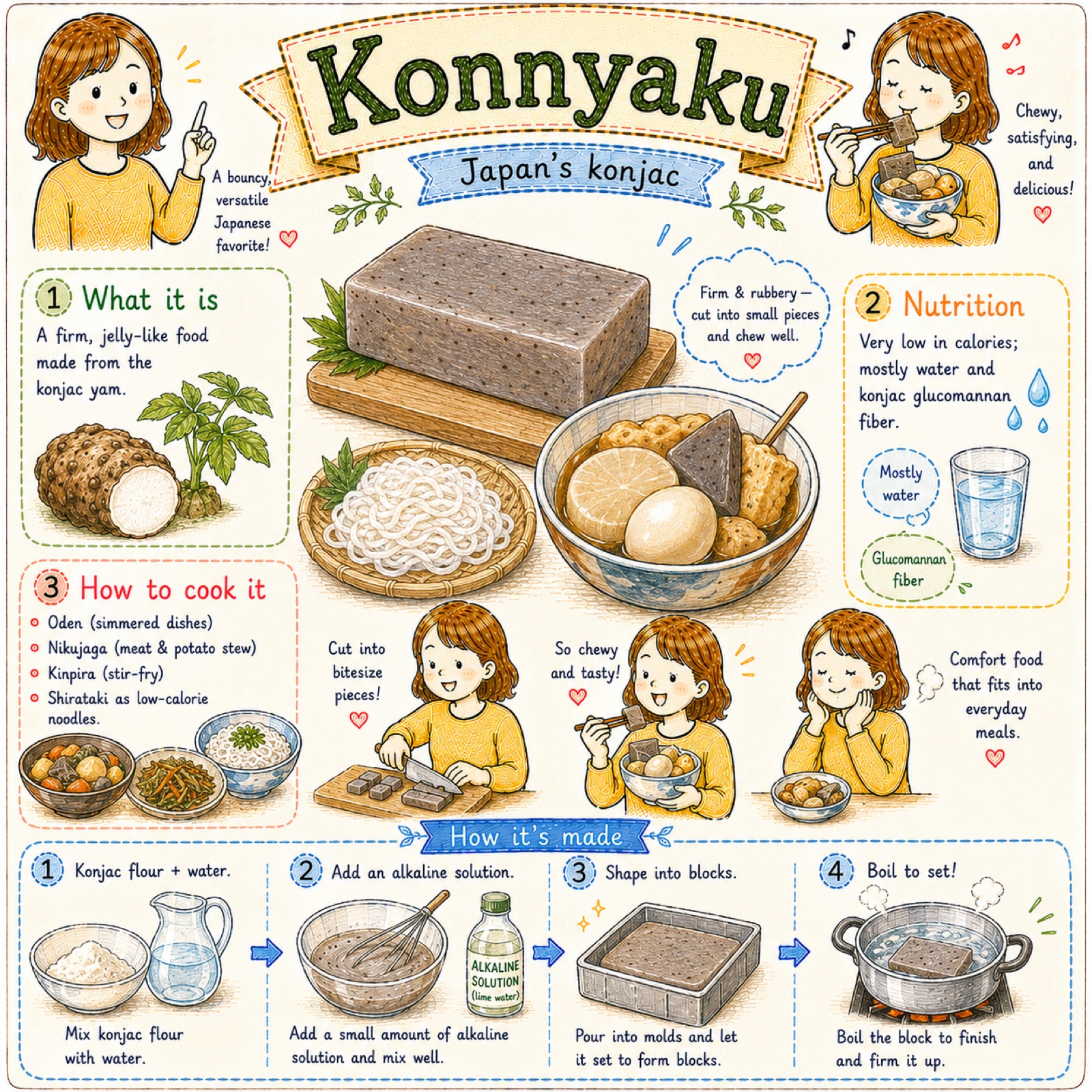
If you’ve ever eaten oden or sukiyaki, you’ve probably met konnyaku without knowing its name — the grey, slightly springy block or the translucent noodles that bob in the broth and soak up every bit of flavor. Made from a humble root, konnyaku is one of the most distinctive foods in the Japanese kitchen: almost no calories, a famously bouncy texture, and an ability to carry whatever seasoning you give it. This guide explains what konnyaku is loved for, the main types, how it’s made, and all the ways to cook with it.
Why Konnyaku Is Loved
Konnyaku has been part of Japanese cooking for centuries, valued for what it adds to a dish and for how little it weighs on a meal.
- Very low in calories. Konnyaku is mostly water, which means a generous serving adds almost no calories to a dish — one reason it’s a favorite for adding bulk and texture to a meal.
- Contains glucomannan, a soluble fiber. The konjac corm is rich in glucomannan, a water-soluble dietary fiber that gives konnyaku both its structure and its satisfying chew.
- A satisfying, springy texture. That signature bounce makes konnyaku filling and fun to eat, and it holds its shape beautifully in soups and simmered dishes.
One honest note on texture and choking: konnyaku is firm and rubbery, so cut it into small, bite-size pieces and chew it well — eaten in large, firm pieces it can be a choking hazard. This is especially true of konjac jelly snacks (the small cup-shaped fruit gels), which are firmer and more slippery than ordinary gelatin desserts and have caused choking; they should be given with particular care to young children and older adults, and many countries place warnings or restrictions on them. Enjoy konnyaku in normal, sensibly cut portions and it’s a wholesome everyday food.
The Types of Konnyaku
Konnyaku comes in a few forms depending on how it’s set and shaped. Here’s how the common ones compare.
| Type | Form | Texture | Best use |
|---|---|---|---|
| Block konnyaku 板こんにゃく |
A solid rectangular cake (pale or seaweed-flecked dark grey) | Firm, dense, and springy | Simmered dishes like oden and nikujaga, kinpira, and stir-fries |
| Shirataki / ito-konnyaku しらたき・糸こんにゃく |
Thin, translucent noodles (the same gel pushed through fine holes) | Slippery and bouncy | Sukiyaki and hot pots; a very low-calorie alternative to noodles |
| Sashimi konnyaku 刺身こんにゃく |
Smooth, thinly sliceable blocks made from refined konjac flour | Soft and delicate, with little odor | Eaten raw, thinly sliced, with a miso-vinegar (sumiso) or wasabi-soy dip |
Sources: Just One Cookbook (Konnyaku/Konjac); Kikkoman (Shirataki); Wikipedia (Amorphophallus konjac; Shirataki noodles; Glucomannan); MAFF Our Regional Cuisines (Sashimi Konnyaku).
What Is Konnyaku, and How Is It Made?
Konnyaku is made from the konjac corm (sometimes called the konjac yam or “devil’s tongue”), an underground tuber whose flesh is rich in the fiber glucomannan. The process is simple and old:
- Dry and grind the konjac corm into a fine, greyish powder called konjac flour (the corm can also be boiled and mashed directly).
- Mix with water. The glucomannan in the flour absorbs water and swells into a thick, gel-like paste.
- Add an alkaline coagulant — traditionally slaked lime (calcium hydroxide) — which sets the paste so it can firm into a solid.
- Shape and boil. The paste is poured into molds, then boiled to set it into the finished springy block (or pushed through fine holes to make noodles).
The little flecks you often see in a block come from a touch of seaweed powder added for the traditional dark look.
How to Cook With Konnyaku
Konnyaku has very little flavor of its own — the whole point is that it drinks up the seasoning around it. A little prep makes all the difference:
- Parboil it first. Boil konnyaku for 2–3 minutes (or rub it with salt and rinse) to remove its faint natural odor and firm up the texture. This quick step is worth doing every time.
- Score or tear it to absorb flavor. Make shallow cuts across the surface, or tear the block into rough pieces instead of slicing it cleanly — the rougher surface lets broth soak in far better.
- Simmer it in classic dishes. Konnyaku is a staple of oden (a winter hot pot), nikujaga (beef and potato stew), and kinpira (a sweet-savory stir-fry with soy sauce and a little chili). It holds its shape through long simmering and only gets tastier.
- Dry-roast it for chew. Toss parboiled konnyaku in a dry pan until the surface squeaks and tightens, then add your sauce — a great way to deepen the texture before a stir-fry.
- Reach for shirataki. The thin noodle form (shirataki or ito-konnyaku) is classic in sukiyaki, and many people use it as a very low-calorie stand-in for noodles in stir-fries and soups. Rinse and parboil it the same way, and dry-fry it briefly to drive off extra moisture before saucing.
How to Choose and Store Konnyaku
- Pick the form for the job. Choose a block for simmered dishes and stir-fries, shirataki/ito-konnyaku for hot pots and noodle-style dishes, and sashimi konnyaku if you want to eat it raw with a dipping sauce.
- Check the packet. Most konnyaku is sold sealed in a pouch of liquid; look for one that’s intact and within its date. There’s usually no need to choose by color — both pale and dark (seaweed-flecked) blocks are normal.
- Store it sealed and cold. Keep unopened konnyaku in the fridge until its use-by date. Once opened, keep any leftover block submerged in clean water in a covered container in the fridge, change the water every day or two, and use it up within a few days. Don’t freeze plain konnyaku — freezing turns it spongy and rubbery.
Frequently Asked Questions
What does konnyaku taste like?
On its own, konnyaku is almost flavorless, with a firm, springy, jelly-like bounce. That mild taste is exactly why it works so well — it absorbs the soy, dashi, and other seasonings of whatever dish it’s cooked in.
Is konnyaku low in calories?
Yes. Konnyaku is mostly water plus the fiber glucomannan, so it’s very low in calories. That’s why shirataki noodles are often used as a light, low-calorie alternative to wheat or rice noodles.
How do I eat konnyaku safely?
Cut konnyaku into small, bite-size pieces and chew it well, since it’s firm and rubbery. Take extra care with konjac jelly snacks, which are firmer and more slippery than ordinary jelly and have caused choking — give them cautiously to young children and older adults, or avoid them for those groups entirely.
What’s the difference between konnyaku and shirataki?
They’re the same food in different shapes. Konnyaku usually means the solid block; shirataki (also called ito-konnyaku) is the same gel pushed into thin, translucent noodles, used in sukiyaki and as a low-calorie noodle.
Do I have to parboil konnyaku?
It’s strongly recommended. A quick 2–3 minute boil (or a salt rub and rinse) removes konnyaku’s slight natural odor and improves both the texture and how well it soaks up flavor.
A Humble Block Worth Knowing
Konnyaku is proof that the plainest-looking foods can be the most useful. From a grey root it becomes a springy block that soaks up broth in oden, slippery noodles in sukiyaki, and chewy bites in a kinpira stir-fry — all for almost no calories. Parboil it, score it, simmer it in something savory, and remember to cut it small and chew it well. Do that, and you’ll see why this quiet, bouncy food has earned its place on the Japanese table.
About the author
KOBUO is the creator of Kobuo’s Japan Guide, sharing authentic Japanese food, traditions, and crafts with curious readers around the world. Every guide is carefully researched and paired with an original hand-drawn illustration. More about Kobuo →