Few tools capture Japanese craftsmanship quite like a kitchen knife. Prized around the world for their sharpness, balance, and beauty, Japanese knives (hocho) are the quiet heroes behind clean cuts, delicate sashimi, and finely sliced vegetables. Each shape has a job, each region its own tradition, and each blade rewards a little care with years of service. This guide explains why Japanese knives are so loved, the main types and what they’re for, how they’re made, and how to care for and choose one.
Why Japanese Knives Are Prized
Japan has forged blades for centuries — the same metalworking heritage that shaped samurai swords now lives on in the kitchen.
- Exceptionally sharp and precise. Japanese knives are typically harder and ground to a finer edge than Western knives, so they cut cleanly with less effort — which keeps ingredients fresh-looking and intact.
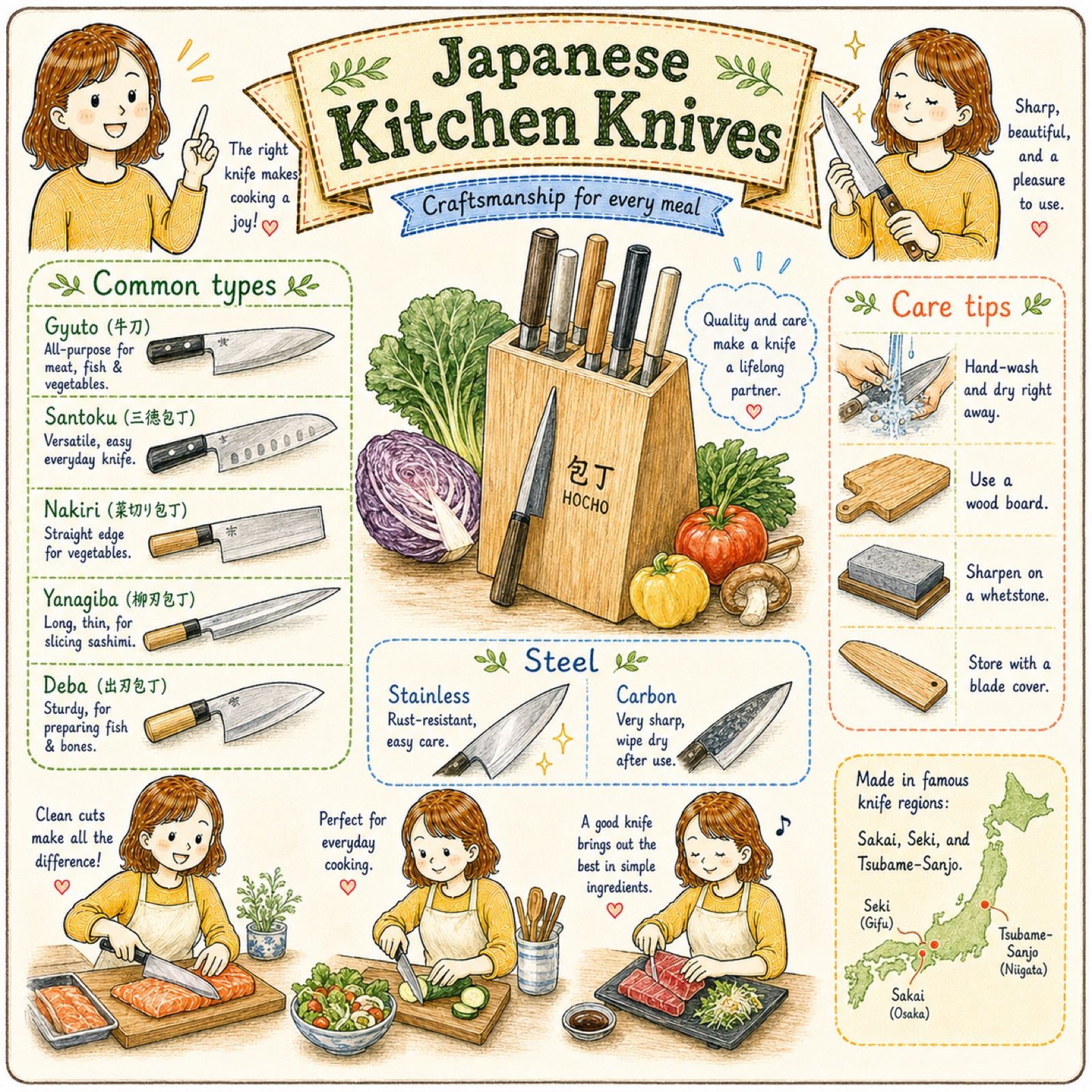
- Made by skilled artisans. Many are still made in traditional knife towns, with forging, sharpening, and handle-fitting often done by specialists. Sakai (Osaka), Seki (Gifu), and Tsubame-Sanjo (Niigata) are the most famous knife-making regions.
- A shape for every task. Rather than one do-it-all blade, Japanese kitchens use specialized knives — a long slicer for fish, a flat blade for vegetables, an all-purpose chef’s knife — each designed to do its job beautifully.
The Main Types of Japanese Knives
There are dozens of shapes, but a handful cover almost everything a home cook needs. Here’s how the common ones compare.
| Knife | Edge | Best for |
|---|---|---|
| Gyuto (牛刀) | Double-bevel | All-purpose chef’s knife — meat, fish & vegetables |
| Santoku (三徳包丁) | Double-bevel | Versatile everyday knife; easy to control |
| Nakiri (菜切り包丁) | Double-bevel | Vegetables — straight edge for clean, square cuts |
| Yanagiba (柳刃包丁) | Single-bevel | Slicing raw fish for sashimi in one smooth pull |
| Deba (出刃包丁) | Single-bevel | Heavy, sturdy — breaking down fish & cutting through bone |
Sources: Knifewear, Hasu-Seizo, Kireaji (knife regions).
What Makes a Japanese Knife Special
Two things set Japanese knives apart: the edge grind and the steel.
- Single-bevel vs. double-bevel. Traditional Japanese knives come in two grinds. Double-bevel (ryoba) blades are sharpened on both sides — easy to use in either hand and the best choice for most cooks (gyuto, santoku, and nakiri are all double-bevel). Single-bevel (kataba) blades are sharpened on one side only, giving incredible precision for tasks like slicing sashimi, but they take skill to use and sharpen (yanagiba and deba are single-bevel).
- Carbon vs. stainless steel. Carbon steel (such as shirogami “white” and aogami “blue” steel) takes an extremely sharp edge and is easy to resharpen, but it rusts easily and must be wiped dry. Stainless steel resists rust and is lower-maintenance, which makes it friendlier for everyday home use. Many knives use a layered “san-mai” construction, with a hard cutting core wrapped in softer, more forgiving steel.
Traditional knives are still forged and ground largely by hand: the steel is heated and shaped, the edge is sharpened on whetstones, and the handle is fitted — a process passed down through generations of craftsmen.
How to Care for a Japanese Knife
A good Japanese knife can last for decades — even generations — with about a minute of care after each use.
- Wash by hand and dry right away. Never put a Japanese knife in the dishwasher. Rinse it, wipe it dry immediately, and it will stay in great shape. This matters most for carbon steel, which will rust if left wet.
- Use the right cutting board. Cut on wood or a soft plastic board — never glass, stone, or ceramic, which quickly dull or chip the fine edge.
- Store it safely. Keep it in a knife stand, on a magnetic strip, or with a blade guard — not loose in a drawer where the edge can knock against other tools.
- Sharpen on a whetstone. Japanese knives are designed to be sharpened on a water whetstone, which keeps the edge keen. Avoid pull-through sharpeners and electric grinders, which remove too much metal and can ruin the grind.
- Know patina vs. rust. On carbon steel, a dull-grey patina naturally forms over time and is harmless (even protective). Orange, flaky rust is different — prevent it by drying the blade well.
How to Choose Your First Japanese Knife
- Start with one versatile blade. A santoku or a gyuto handles the vast majority of everyday cooking — meat, fish, and vegetables. If you cook a lot of vegetables, add a nakiri.
- Choose stainless if you want low maintenance. Stainless steel is the easier, worry-free choice for most home cooks; reach for carbon steel once you enjoy the ritual of drying and sharpening.
- Match the knife to what you cook. Only buy a yanagiba or deba if you regularly break down whole fish or slice sashimi — they’re specialists, not starters.
- Buy from a reputable maker. Knives from the traditional regions (Sakai, Seki, Tsubame-Sanjo) come with generations of know-how behind them.
Frequently Asked Questions
What’s the difference between a gyuto and a santoku?
Both are all-purpose, double-bevel knives. A gyuto is the Japanese take on a Western chef’s knife — longer, with a pointed tip and a gentle curve for rocking cuts. A santoku is shorter and flatter with a rounded tip, which many home cooks find easier to control. Either makes an excellent first knife.
Are Japanese knives single- or double-edged?
It depends on the type. Everyday knives like the gyuto, santoku, and nakiri are double-bevel (sharpened on both sides) and work for left- or right-handed cooks. Traditional yanagiba and deba are single-bevel (sharpened on one side) for extra precision, and are usually made right-handed.
Do I need to oil or special-treat my knife?
A stainless knife just needs washing and drying. A carbon steel knife benefits from being wiped completely dry after use, and a light food-safe oil if you’re storing it for a long time. Day to day, drying it well is the main thing.
Can I put a Japanese knife in the dishwasher?
No. The heat, harsh detergent, and knocking around will damage the edge and can rust carbon steel. Always hand-wash and dry a Japanese knife.
How often should I sharpen it?
For a home cook, touching up the edge on a whetstone every few weeks to a couple of months keeps it cutting beautifully — more often if you cook daily. A well-kept knife rarely needs a major regrind.
A Blade Worth Caring For
A Japanese kitchen knife is craftsmanship you use every day. Pick one versatile blade to start, treat it to a quick wash-and-dry after cooking, keep it off glass cutting boards, and sharpen it on a whetstone now and then — and it will reward you with clean, effortless cuts for years. It’s one of the most satisfying pieces of Japanese culture you can bring into your own kitchen.
About the author
KOBUO is the creator of Kobuo’s Japan Guide, sharing authentic Japanese food, traditions, and crafts with curious readers around the world. Every guide is carefully researched and paired with an original hand-drawn illustration. More about Kobuo →