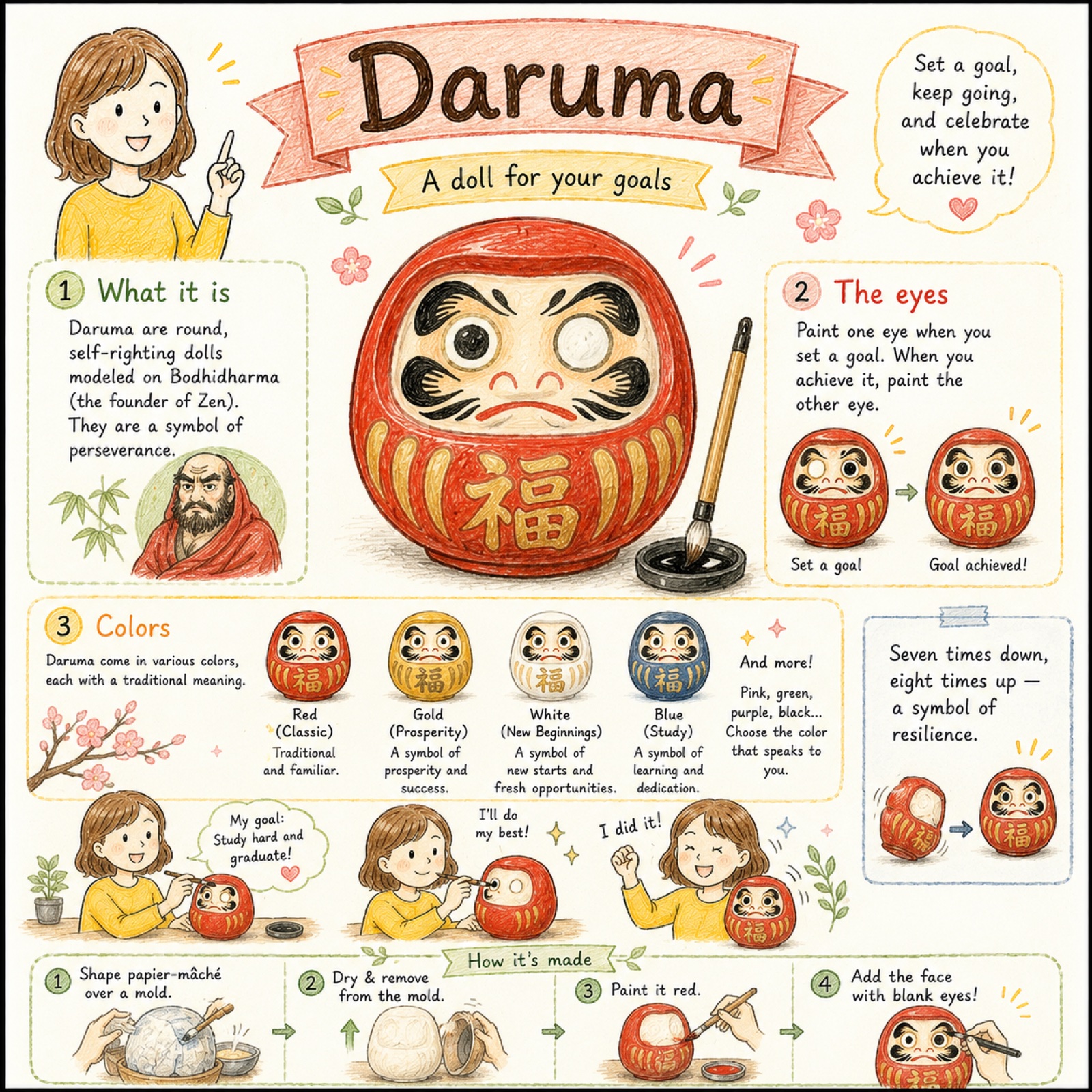
Walk into a Japanese home, a shop, or a small temple near New Year, and you may spot a round, red figure with a determined face and two large, blank white eyes staring back at you. That’s a daruma — perhaps the most beloved good-luck doll in Japan, and one of the few you actually finish yourself. Buy one, make a wish, and paint in a single eye. The doll waits, eyeing your goal, until the day you fill in the second eye to celebrate.
Part talisman, part personal companion, part gentle nudge to keep going, the daruma is a wonderfully hands-on piece of Japanese culture. Here’s what it means, where it comes from, and exactly how to use one.
What a Daruma Symbolizes
More than anything, the daruma is a symbol of perseverance and determination. Its weighted, rounded bottom means that if you knock it over, it rights itself every time — a quality called okiagari, “getting up and rising.” This is tied to the much-loved Japanese saying nanakorobi yaoki, “seven times down, eight times up.”
That spirit makes the daruma a natural companion for goal-setting. Because of this, it is traditionally given as a gift of encouragement — to students before exams, to people starting a business, or to anyone facing a long challenge. The doll’s blank eyes turn a private hope into something you can see on the shelf every day.
The Colors and Types of Daruma
The classic daruma is bright red, a color long linked to Bodhidharma’s robes and, in East Asian tradition, to luck and protection. Over time, other colors appeared, each said to carry its own association — gold for prosperity, white for new beginnings, black for warding off misfortune, and more. You’ll find a full breakdown in the color table below. Daruma also come in many sizes, from tiny palm-sized charms to grand dolls displayed at companies and temples.
| Color | Traditional Association | Often Wished For |
|---|---|---|
| Red | The classic color, linked to Bodhidharma’s robes; said to symbolize luck and protection. | General good fortune, all-purpose goals |
| Gold / Yellow | Traditionally associated with wealth and glory. | Money, business prosperity |
| White | Said to represent purity and balance; sometimes a fresh start. | Harmony, new beginnings, exam success |
| Black | Traditionally believed to ward off misfortune and evil. | Protection, warding off bad luck |
| Purple | Long a color of nobility; associated with health and self-improvement. | Well-being, personal growth |
| Pink | A modern favorite, associated with love and relationships. | Romance, matters of the heart |
| Gold-yellow / Green | Green is often linked to health and study; associations vary by maker. | Health, academic goals |
Sources: Japan Objects — What are Daruma?; Japan National Tourism Organization — Takasaki Daruma; Wikipedia — Daruma
What Is a Daruma, and Where Does It Come From?
A daruma is a hollow, round, papier-mâché doll modeled on Bodhidharma (in Japanese, Bodaidaruma) — the Indian monk who, according to tradition, founded the Zen school of Buddhism. Legend says he meditated facing a wall for nine years, and his armless, legless shape in the doll reflects that long, unbroken concentration.
The most famous production center is Takasaki, in Gunma Prefecture, said to make the large majority of Japan’s daruma. There, monks of the Shorinzan Darumaji temple are credited with popularizing the dolls as talismans for local farmers. Today they’re still made largely by hand:
- Forming the body. Layers of washi (Japanese paper) are pasted over a mold to build the hollow, rounded shell.
- Weighting the base. The bottom is weighted so the doll self-rights when tipped — the okiagari effect.
- Painting the face. The body is painted (traditionally red), and the face, beard, and details are added by hand.
- Leaving the eyes blank. The two eyes are left as plain white circles, ready for you to fill in.
How to Use a Daruma
Using a daruma is a simple, satisfying ritual that unfolds over time.
- Set a goal or make a wish. Decide on something specific — passing an exam, finishing a project, a good year ahead. Many people make a wish at the start of the year, but any moment works.
- Paint in the first eye. As you fix your goal in mind, paint in one eye (traditionally the doll’s left eye, which is on your right as you face it). This is said to seal your commitment, almost like a promise made in front of a witness.
- Display it where you’ll see it. Set the daruma somewhere visible — a desk, a shelf, a household altar. With one eye watching you, it serves as a daily reminder of what you’re working toward.
- Paint the second eye on success. When your wish is fulfilled, fill in the other eye to complete the face. This is the celebratory moment the whole ritual builds toward — a small thank-you and a sign that the goal is done.
- Return it at year-end. Traditionally, after about a year — whether or not the wish came true — people bring the daruma back to a temple to be respectfully burned in a ceremony called daruma kuyo. It’s said to release the wishes the doll carried and clear the way for new ones, often around New Year or early February.
How to Choose and Care for a Daruma
Pick a size that suits where you’ll keep it — a small daruma is easy to place on a desk, while a larger one makes a bold statement for a big goal or a gift. For your first one, the traditional red is a safe and meaningful choice, but it’s perfectly fine to choose a color whose association speaks to you.
Care is easy: keep your daruma somewhere clean and dry, dust it gently, and treat it with a little respect, as many people do with a meaningful charm. When the year is done, returning it to a temple is the customary way to part with it, rather than simply throwing it out.
Frequently Asked Questions
Which eye do I paint first?
Custom is to paint one eye when you make the wish and the other when it comes true. The first eye is traditionally the doll’s left (your right as you face it), though practices vary by region and family.
What do the daruma colors mean?
Red is the classic color, traditionally associated with luck and protection. Other colors carry their own associations — gold with prosperity, white with new beginnings, black with warding off bad fortune, and so on. See the table above for more.
What should I do when my wish comes true?
Fill in the second eye to complete the face and celebrate. Then, around year-end, it’s traditional to return the daruma to a temple to be burned in a daruma kuyo ceremony.
Do I have to throw it away if my wish didn’t come true?
Not at all. The tradition is to return the doll after about a year regardless of the outcome, as a way of drawing a line under the year and starting fresh — not as a sign of failure.
Can anyone use a daruma?
Yes. While it grew out of Buddhist tradition, the daruma today is a widely loved cultural symbol that many people — Japanese or visitors, religious or simply curious — enjoy as a charm of encouragement.
A Doll That Keeps You Going
The charm of the daruma is that it isn’t finished when you buy it — you finish it. One eye marks the moment you dare to hope; the other, the day that hope comes true. In between, that round, unfalling little figure sits on your shelf, quietly reminding you of the oldest piece of advice it carries: fall down seven times, get up eight. Make a wish, pick up a brush, and let your daruma keep watch over the year ahead.
About the author
KOBUO is the creator of Kobuo’s Japan Guide, sharing authentic Japanese food, traditions, and crafts with curious readers around the world. Every guide is carefully researched and paired with an original hand-drawn illustration. More about Kobuo →