Hold a piece of Edo kiriko up to the light and it seems to catch fire. A web of fine cuts splinters the light into glittering facets, while a band of deep blue or ruby red glows along the rim. This is Edo kiriko (江戸切子) — the traditional cut glass of Tokyo — and it is one of Japan’s most dazzling everyday crafts: a sake cup, tumbler, or bowl that turns an ordinary sip of water into something that sparkles. Here’s what it is, the patterns you’ll see, and how to keep a piece looking its best.
Why Edo Kiriko Is Loved
Three things make Edo kiriko unforgettable.
The first is sparkle. Each cut is hand-ground into the surface of the glass, and those tiny angled facets scatter light in every direction. Fill an Edo kiriko glass with a clear drink and the whole vessel seems to twinkle.
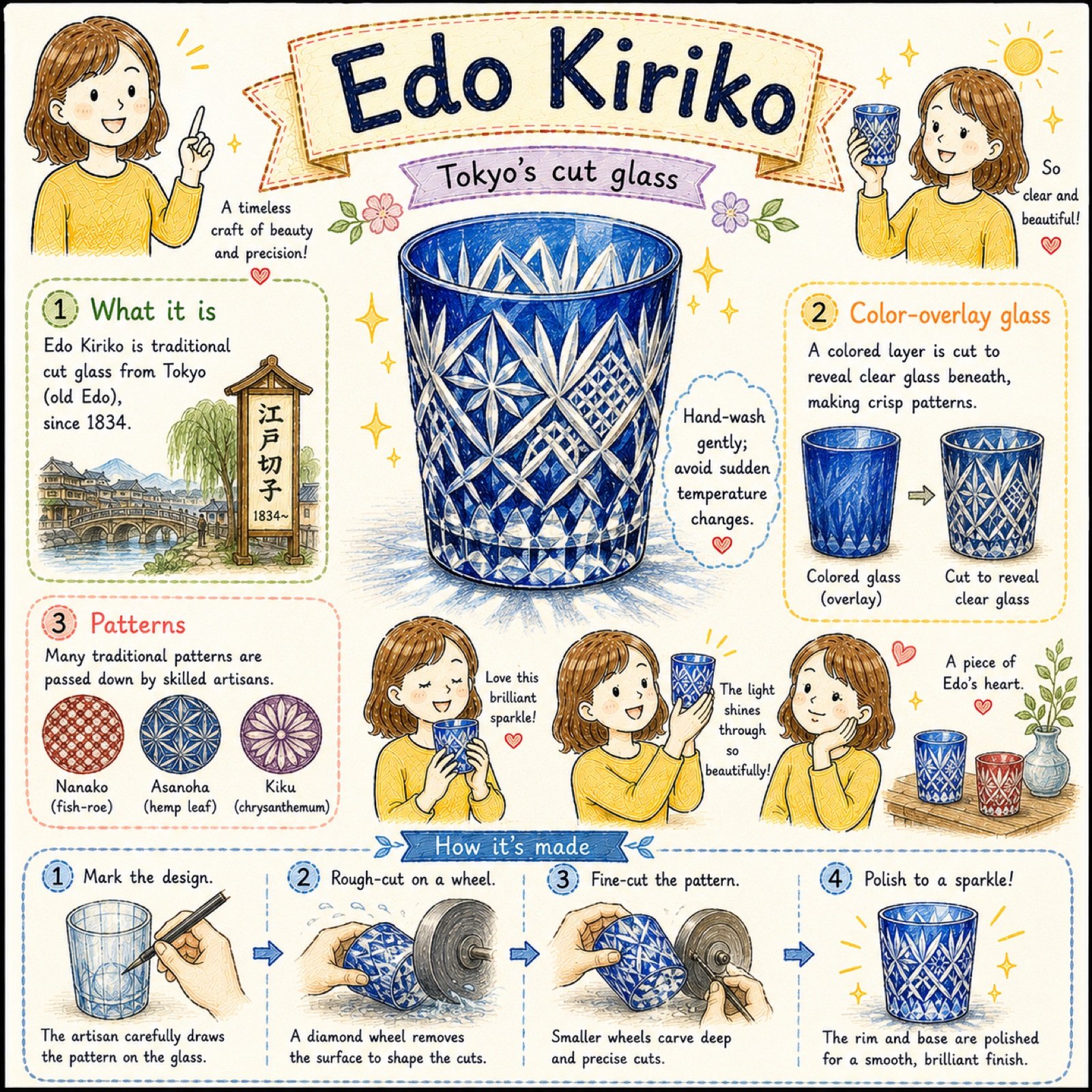
The second is color contrast. Classic Edo kiriko uses colored-overlay glass: clear glass wrapped in a thin colored skin, usually deep blue (ruri) or red (aka). When the artisan cuts through that colored layer, the clear glass beneath is revealed — so every line shows up as a crisp, bright stroke against a jewel-toned background. The effect is sharp, graphic, and instantly recognizable.
The third is craftsmanship. Edo kiriko is a craft officially designated as traditional by both the Tokyo Metropolitan and Japanese national governments. Every facet is cut by a skilled artisan against a spinning wheel, entirely by hand and eye — which is why no two pieces are ever exactly alike.
The Patterns of Edo Kiriko
Edo kiriko’s beauty lives in its repeating geometric patterns, most of which are drawn from much older Japanese textile and basketry motifs. A few you’ll meet again and again:
- Nanako (魚子) — countless tiny round cuts that catch the light like a cluster of fish eggs (“nanako” means “fish roe”).
- Asanoha (麻の葉) — a six-pointed star repeated into an interlocking hemp-leaf lattice.
- Kiku / Kiku-tsunagi (菊・菊繋ぎ) — radiating lines that form chrysanthemum blooms, often linked edge to edge into a dense mesh.
- Yarai (矢来) — crossed diagonal lines inspired by a bamboo fence.
- Kagome (籠目) — an open hexagonal weave that mimics the lattice of a bamboo basket.
- Shippo (七宝) — overlapping circles forming an endless chain of “seven treasures.”
A full comparison of these motifs follows below.
| Pattern (Japanese) | What it looks like | What it represents |
|---|---|---|
| Nanako (魚子) | Countless tiny round cuts that twinkle like rows of fish eggs | “Fish roe”; associated with thriving, prosperous descendants |
| Asanoha (麻の葉) | A repeating six-pointed star forming an interlocking hemp-leaf lattice | Hemp leaf; healthy growth and protection from harm |
| Kiku-tsunagi (菊繋ぎ) | Radiating lines forming chrysanthemum blooms, linked into a dense mesh | Chrysanthemum (Japan’s imperial flower); longevity and renewal |
| Yarai (矢来) | Crossed diagonal lines, like a bamboo fence | Bamboo fencing; warding off misfortune |
| Kagome (籠目) | An open hexagonal weave mimicking a woven bamboo basket | Basket weave; traditionally believed to keep evil at bay |
Sources: Musubi Kiln (“Guide to Edo Kiriko”); WA MARE (“The Profound Meanings of Traditional Edo Kiriko Patterns”); Wikipedia (“Edo kiriko”). Pattern meanings reflect widely held traditional cultural symbolism.
What Is Edo Kiriko, and How Is It Made?
Edo kiriko is hand-cut glass that traces its origin to 1834, when a glassware merchant named Kagaya Kyubei began carving patterns into the surface of glass in Edo (the old name for Tokyo), using emery sand to grind the designs. The craft grew through the Meiji era as European cutting and glassmaking techniques arrived in Japan, and it remains centered in Tokyo’s Koto and Sumida wards today.
The signature material is colored-overlay (cased) glass — a clear glass body coated with a thin layer of colored glass. Cutting through that layer is what produces Edo kiriko’s hallmark contrast between bright color and clear glass.
Making a single piece follows several careful stages, all done by hand:
- Atari (marking). The artisan draws guide lines onto the blank glass to map out where the pattern will go.
- Arazuri (rough cutting). Using a coarse diamond wheel and a trickle of water, the artisan grinds the basic outline of the design into the surface.
- Sanban-gake (fine cutting). Finer wheels trace over the rough cuts, sharpening the lines and adding detail.
- Migaki (polishing). The cut surfaces are polished with wooden or resin wheels — and sometimes a final felt or brush finish — until they shine.
The whole process depends on the artisan’s eye and steady hand; there is no print or mold for the pattern.
How to Choose Edo Kiriko
Color. Blue (ruri) and red (aka) are the timeless classics, but modern makers offer purple, green, amber, and more. Some pieces are double-overlaid in two colors.
Pattern. Pick a motif you love, and remember that finer, denser patterns (like nanako) generally take more cutting and command a higher price.
Form. Edo kiriko comes as sake cups (small, jewel-like, a wonderful first piece), tumblers and rocks glasses (a popular gift for whisky and cocktail lovers, where the cuts shine through the drink), and bowls and vessels for the table. Choose by how you’ll actually use it.
Buying as a gift. Edo kiriko is a beloved present in Japan. A boxed sake cup or a single tumbler makes an elegant, distinctly Tokyo gift.
Edo vs. Satsuma kiriko. You’ll also see Satsuma kiriko, a cut glass from Kagoshima (formerly the Satsuma domain). The key difference is the colored layer: Satsuma uses a thicker color coat, so its cuts produce a soft **gradation (bokashi) — color fading gently from deep to clear. Edo kiriko’s thinner layer instead gives a sharp, crisp edge** between color and clear. Neither is “better” — Edo is bold and graphic, Satsuma is soft and painterly.
How to Care for Edo Kiriko
Edo kiriko is delicate, but easy to keep beautiful with a few habits:
- Hand-wash only. Use lukewarm water, a mild detergent, and a soft sponge. Never use a dishwasher — the heat, harsh detergents, and jostling can dull the cuts or chip the glass. Avoid abrasive scrubbers and bleach.
- Avoid thermal shock. Don’t pour boiling liquid into a cold glass or move it suddenly between hot and cold; a sharp temperature change can crack it.
- Dry and store gently. Pat dry with a soft cloth. Store pieces upright and unstacked; if you must stack them, slip a soft cloth between each one.
Treated kindly, a piece of Edo kiriko will keep its sparkle for generations.
Frequently Asked Questions
What’s the difference between Edo kiriko and Satsuma kiriko?
Both are Japanese cut glass made from colored-overlay glass. Edo kiriko (from Tokyo) uses a thin color layer, giving sharp, crisp contrast between the color and the clear glass beneath. Satsuma kiriko (from Kagoshima) uses a thicker color layer, producing a soft color gradation called bokashi.
Can Edo kiriko go in the dishwasher?
No. Always wash it by hand with lukewarm water, mild detergent, and a soft sponge. Dishwasher heat and harsh detergents can dull the cut facets and risk chipping the glass.
Why does Edo kiriko have a colored layer?
The classic glass is “cased”: clear glass coated with a thin colored layer. When the artisan cuts through that layer, the clear glass shows through, so each cut line stands out brightly against the color — that contrast is the whole point of the design.
What do the patterns mean?
Most patterns are borrowed from old Japanese textile and basketry motifs, each with a traditional association — asanoha (hemp leaf) with healthy growth, kagome and yarai (basket weave and bamboo fence) with warding off misfortune, kiku (chrysanthemum) with longevity, and shippo (seven treasures) with harmony and good fortune.
Is Edo kiriko expensive?
Prices range widely. A simple sake cup can be quite affordable, while pieces with dense, finely cut patterns or two-color overlays — each one slowly hand-cut by a master — cost considerably more.
A Piece of Tokyo Light
Edo kiriko began with one merchant cutting patterns into glass in old Edo, and nearly two centuries later it still does the same magical thing: it takes plain light and turns it into color and sparkle. Pour a little water, lift the glass to a window, and you’ll understand at once why Tokyo has treasured this craft for so long — a small, glittering piece of the city you can hold in your hand.
About the author
KOBUO is the creator of Kobuo’s Japan Guide, sharing authentic Japanese food, traditions, and crafts with curious readers around the world. Every guide is carefully researched and paired with an original hand-drawn illustration. More about Kobuo →