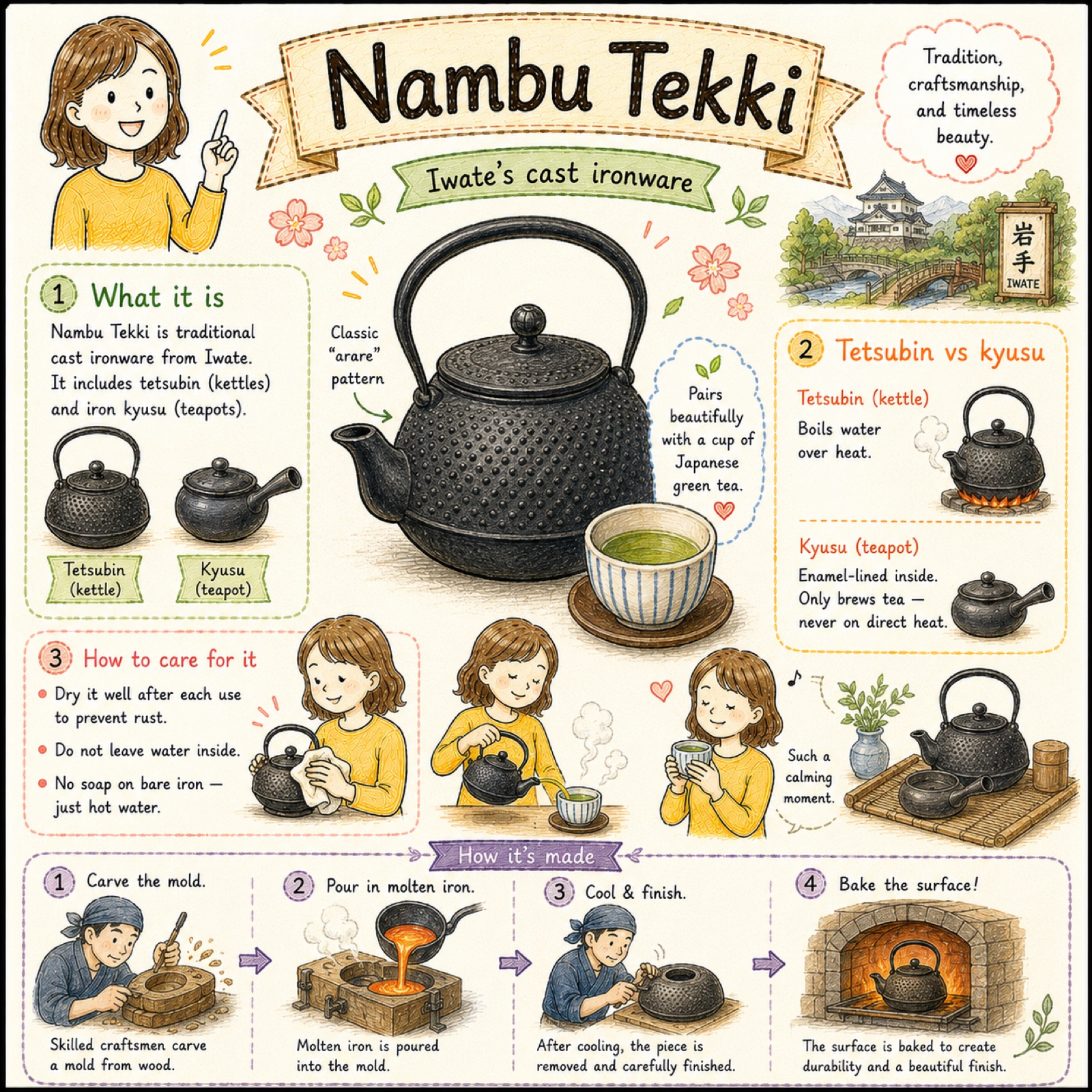
If you’ve ever admired a heavy, dimpled black iron pot at a Japanese tea house and wondered whether it’s a teapot or a kettle, you’ve met Nambu tekki — the celebrated cast ironware of Iwate Prefecture. It looks like a single object, but it’s really two very different tools wearing similar clothes: one boils your water, the other brews your tea. Get that distinction right and a piece of Nambu tekki can serve you for decades. Get it wrong, and you can crack an enamel lining on the stove. This guide walks through what Nambu tekki is, how it’s made, and exactly how to use and care for each kind — a perfect companion to a good cup of Japanese green tea.
Why Nambu Tekki Is Loved
Nambu tekki has been treasured for some 400 years, and the reasons are easy to feel the moment you pick a piece up.
- Hand craftsmanship. Each piece is cast by hand in a labor-intensive process of more than ten steps. The signature pebbled “arare” (hailstone) pattern and the deep matte-black finish are the marks of a skilled artisan, not a machine.
- Excellent heat retention. Thick cast iron holds heat beautifully. Water in a tetsubin stays hot for a long time, and the gentle, even warmth is part of why it’s so prized for tea.
- Quiet beauty. The rough, textured surface and substantial weight give Nambu tekki a calm, grounded presence — “usable art” that looks as good on the table as it performs.
- Durability. Well cared for, a tetsubin can last a lifetime and be passed down through generations. It is the opposite of a disposable object.
Tetsubin vs Iron Kyusu
This is the single most important thing to understand, so it’s worth stating plainly. A tetsubin (鉄瓶) is a cast-iron kettle used to boil water over a heat source; its interior is bare iron. An iron kyusu (鉄急須) is a teapot used to steep tea; its interior is usually enamel-lined so it won’t rust.
That lining changes everything. Because a kyusu is coated inside with enamel, it must never go on direct heat — the enamel can crack. A bare-iron tetsubin, by contrast, is built to sit over a flame. (A full side-by-side comparison appears below.)
| Tetsubin (鉄瓶) — iron kettle | Iron kyusu (鉄急須) — iron teapot | |
|---|---|---|
| Purpose | Boil water over a heat source | Steep and serve brewed tea |
| Interior | Bare cast iron (no lining) | Usually enamel-lined, so it won’t rust |
| Can it go on direct heat? | Yes — it’s made to sit over a flame | No — direct heat can crack the enamel |
| Effect on water / tea | Can add a little iron; traditionally said to soften the water’s taste | Lined, so it doesn’t change the flavor |
| Care | Dry thoroughly after each use; no detergent or steel wool inside; never leave water standing | Easy — rinse with a soft sponge and dry; enamel resists rust |
Sources: KOGEI JAPAN (Nambu Ironware); Globalkitchen Japan, “What is the difference between Tetsukyusu and Tetsubin?”; Native & Co, “Daily Care for Nambu Tekki Ironware”; Musubi Kiln, “How to Care for Nambu Ironware”.
What Is Nambu Tekki, and How Is It Made?
Nambu tekki is the cast ironware of Iwate Prefecture in northern Japan, produced today in two centers: Morioka City and Mizusawa (Oshu City). Morioka’s tradition is said to have begun in 1659, when the lord of the Nambu domain — a keen student of the tea ceremony — invited a Kyoto kettle-maker to cast tea kettles using the domain’s good local iron. Mizusawa’s casting tradition is even older, with roots stretching back centuries. In 1975, Nambu ironware was designated a national traditional craft of Japan.
Each piece is still made largely by hand. In simplified form:
- Design and pattern. The shape and any surface pattern (such as the arare hailstone dots) are decided, and a master pattern is prepared.
- Building the mold. Sand and clay are layered to form the mold, with the artisan refining the surface by changing the grain of the sand.
- Casting. The mold is heated, and molten iron — at roughly 1,300–1,500°C — is poured in and left to cool.
- Finishing and the rust-resisting bake. Once the piece is removed from the mold, the interior is baked at high heat (around 900°C). This forms a protective oxide film — known as kuro-sabi, or “black rust” — that helps guard the inside against rust. A final coloring and finishing complete the piece.
How to Use a Tetsubin or Iron Kyusu
Boiling water in a tetsubin. This is what a tetsubin is for. Set it on your heat source — gas, an electric coil, or a traditional charcoal brazier — and bring the water to a boil. Some pieces are induction-compatible, but check the maker’s note before assuming. Boiling water in a bare-iron tetsubin can add a small amount of iron to the water and is traditionally said to soften and round out its taste, which is part of its long appeal for tea. Use that freshly boiled water to brew green tea at the right temperature, and you have an ideal pairing.
Brewing tea in an enamel-lined kyusu. An iron kyusu is a teapot. Add your tea leaves, pour in hot water (boiled separately — for example, in your tetsubin or a kettle), let it steep, and pour. The enamel lining means it won’t add iron or change the tea’s flavor; it’s simply a beautiful, heat-retaining pot for serving.
Why you must not heat a kyusu on the stove. Because the kyusu is enamel-lined inside, putting it on direct heat can crack the enamel and ruin it. Keep your kyusu off the burner entirely — it only ever holds already-hot water.
First-use seasoning (tetsubin). Before its first proper use, rinse the inside of a new tetsubin with lukewarm water a couple of times, then fill it, bring it to a boil, and discard the water. Repeating this two or three times helps settle the surface and remove any initial metallic taste.
How to Care for Nambu Tekki
The golden rule for bare iron is simple: keep it dry.
- Dry thoroughly after every use. For a tetsubin, empty it while it’s still warm and let the residual heat evaporate the last drops; if needed, set it back over a very low flame for a few seconds. Standing water is the main cause of rust.
- Don’t leave water sitting in it. Empty a tetsubin after use rather than storing water inside.
- No detergent or steel wool on a bare-iron interior. Do not scrub the inside of a tetsubin with dish soap, cleanser, or steel wool — doing so strips the protective film. A quick rinse with hot water is all it needs; never touch the inner surface unnecessarily.
- An enamel kyusu is easier. Because it’s lined, a kyusu can simply be rinsed with a soft sponge inside and dried. The enamel resists rust even if a little water remains, though drying it is still good practice.
- Handling rust. A little reddish rust inside a tetsubin is normal over time and usually harmless. If boiled water comes out clear and odorless, keep using it; if it looks rusty, boil with used green tea leaves a few times — the tannins react with the iron to darken and calm the spots. (Don’t try to scour rust off bare iron.)
- Storage. Store completely dry, with the lid slightly ajar so any moisture can escape, in a well-ventilated spot.
Frequently Asked Questions
What’s the difference between a tetsubin and an iron kyusu?
A tetsubin is a cast-iron kettle for boiling water over heat; its inside is bare iron. An iron kyusu is a teapot for steeping tea; its inside is usually enamel-lined. In short: a tetsubin makes the hot water, a kyusu brews the tea.
Can I put my iron kyusu on the stove?
No. An enamel-lined kyusu must never go on direct heat, because the enamel can crack. Only a bare-iron tetsubin is made to sit over a flame.
How do I keep Nambu tekki from rusting?
Dry it thoroughly after every use. Empty a tetsubin while it’s warm so residual heat evaporates the water, never leave water standing inside, and don’t scrub the bare-iron interior with detergent or steel wool. Store it fully dry with the lid slightly open.
Does boiling water in a tetsubin really change the water or tea?
Boiling water in a bare-iron tetsubin can add a small amount of iron to the water, and it is traditionally said to make the water taste softer and rounder — one reason it’s long been favored for tea. An enamel-lined kyusu, being coated inside, does not change the flavor.
Is Nambu tekki induction-compatible?
Some pieces are, and some aren’t — it depends on the design. Check the maker’s information for your specific tetsubin before using it on an induction hob. (A kyusu, of course, never goes on any heat.)
Slow Tea, Built to Last
Nambu tekki rewards the same patience as the tea it serves. Choose the right piece for the job — a tetsubin to boil, a kyusu to brew — keep it dry, and treat the iron kindly, and it will quietly outlast almost everything else in your kitchen. Pour freshly boiled water from a tetsubin over a good sencha or matcha, and you’ll taste exactly why this 400-year-old craft and Japan’s green tea have always belonged together.
About the author
KOBUO is the creator of Kobuo’s Japan Guide, sharing authentic Japanese food, traditions, and crafts with curious readers around the world. Every guide is carefully researched and paired with an original hand-drawn illustration. More about Kobuo →