Walk into a Japanese restaurant, a corner shop, or a souvenir stall almost anywhere in Japan, and sooner or later a small ceramic cat will catch your eye — one paw raised high, a coin clutched to its chest, a permanent cheerful smile on its face. That’s the maneki-neko (招き猫), the “beckoning cat,” one of the most recognizable good-luck charms in the world.
But there’s more going on than a cute pose. Which paw is raised, what color the cat is, and what it’s holding all carry traditional meaning. Here’s what the beckoning cat symbolizes, where it comes from, and how to choose one that fits the wish you have in mind.
What a Maneki-neko Symbolizes
The maneki-neko is a figurine — usually of a sitting cat with one paw raised — that is traditionally believed to bring good luck and good fortune to its owner. You’ll most often see one perched by the register in shops and restaurants, where it’s said to “beckon” customers and prosperity through the door.
The pose itself is the key to its name. To Western eyes the raised paw can look like a friendly wave, but in Japan a beckoning gesture is made with the palm facing out and the fingers folding down and back — exactly the motion the cat is frozen in. So rather than waving goodbye, the maneki-neko is inviting you in: come closer, good things are this way.
What the Paws and Colors Mean
Two details decide what a particular cat is “asking for”: which paw it raises, and what color it is.
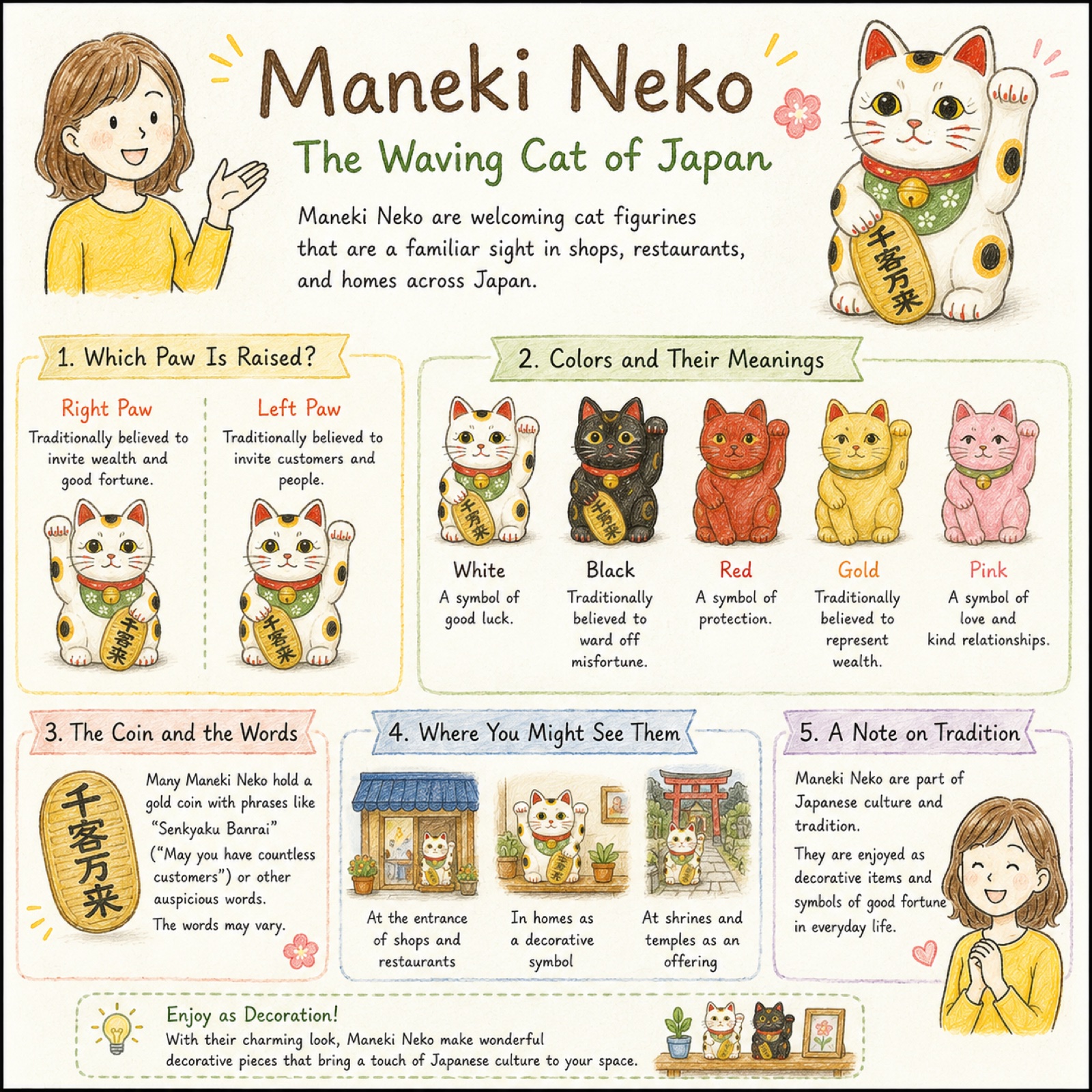
- Left paw raised is traditionally said to beckon people — customers, guests, and visitors.
- Right paw raised is traditionally said to beckon money and wealth.
- Some cats raise both paws, said to invite people and prosperity together.
Color carries its own traditional associations — calico, white, black, gold, red, and pink each have a meaning, which we break down in the comparison table further below.
| Color | Japanese name / note | Traditionally believed to represent |
|---|---|---|
| Calico | Mi-ke (三毛) — white with black & red/orange | The classic and most popular; considered the luckiest of all. |
| White | Shiro (白) | Purity and happiness. |
| Black | Kuro (黒) | Warding off bad luck and misfortune. |
| Gold | Kin (金) | Wealth and financial fortune. |
| Red | Aka (赤) | A traditional symbol of health and protection. |
| Pink | Momoiro (桃色) | Love and romance. |
| Raised paw | Traditionally said to beckon | Often chosen for |
|---|---|---|
| Left paw | People — customers, guests, visitors | Shops, cafés, welcoming entryways |
| Right paw | Money and wealth | The home; wishes for prosperity |
| Both paws | People and prosperity together | Those who want a bit of everything |
Sources: Wikipedia (Maneki-neko); SFO Museum, “Maneki Neko: Japan’s Beckoning Cat”; Catster; Bokksu; The American Ceramic Society. Color and paw meanings are traditional cultural beliefs and vary by region and source.
What Is a Maneki-neko, and Where Does It Come From?
A maneki-neko is a sculpted beckoning cat, traditionally modeled on the calico Japanese Bobtail. It’s most commonly made as ceramic ware, and several of Japan’s famous pottery towns are known for it — the Imado kilns of old Edo (today’s Tokyo) are credited with the earliest examples in the mid-19th century, while Seto and Tokoname in Aichi Prefecture became major centers as the cats grew popular.
Several charming origin legends compete for the title of “the first lucky cat”:
- Gotoku-ji temple (Tokyo). The best-known legend tells of a feudal lord, Ii Naotaka, who was passing the temple during the Edo period when a cat at the gate seemed to beckon him inside. He followed it in, and moments later a thunderstorm broke where he had been standing. Grateful, he made the once-poor temple his family temple, and it prospered. Gotoku-ji is filled with hundreds of white beckoning cats to this day.
- Imado (Tokyo). Another tale describes a poor old woman who had to part with her beloved cat. The cat appeared to her in a dream and told her to make its likeness in clay — she did, sold the figures, and her fortunes turned. This ties the cat to Imado-ware pottery.
Here is roughly how a traditional ceramic maneki-neko comes to life:
- Shape the form. Clay is pressed into a mold (or shaped by hand) to form the sitting cat with its raised paw.
- Dry and fire. The piece is dried, then fired in a kiln to harden it.
- Paint and detail. Artisans hand-paint the face, the collar and bell, the coloring of the coat, and the gold koban coin.
- Glaze and finish. A final glaze or coat gives the cat its glossy, cheerful shine.
How to Choose and Display a Maneki-neko
There’s no single “correct” cat — the fun is matching one to your wish.
Pick the paw for your goal. Because the left paw is traditionally said to draw in people and the right to draw in money, a common rule of thumb is: a left-paw cat for places that want more visitors (a shop, a café, a welcoming entryway) and a right-paw cat for the home or anywhere the wish is for prosperity. A both-paws cat covers both, though some feel raising both is a touch greedy — choose what speaks to you.
Pick the color for your wish. Calico (mi-ke) is the classic and traditionally considered the luckiest; white is associated with purity and happiness; gold with wealth; black is traditionally believed to ward off bad luck; red is a traditional symbol of health and protection; and pink is associated with love. (See the table below.)
Mind what it’s holding. Many cats clutch a koban, an oval gold coin from the Edo period. It’s often marked sen-man-ryo (千万両) — “ten million ryo” — a playfully enormous sum that symbolizes the wealth the cat beckons. Others hold a fish, a gourd, or a magic mallet, each a small token of plenty.
Where to place it. Following the beckoning idea, a maneki-neko is traditionally placed where it can “welcome” — near the entrance facing the door, or by the register in a shop. At home, many people set it in a living room, a hallway, or near the front door. Put it somewhere it can be seen, ideally a little above eye level, so it greets people as they arrive.
How to Care for a Maneki-neko
A ceramic maneki-neko asks for very little. Keep it somewhere stable where it won’t be knocked off a shelf, since ceramic and porcelain chip easily. Dust it gently with a soft, dry cloth; for a painted or glazed cat, a barely-damp cloth is fine, but avoid soaking it or scrubbing the hand-painted details. Keep it out of harsh direct sunlight over long periods, which can fade the colors. That’s really all it takes — a well-kept cat can cheerfully beckon for decades.
Frequently Asked Questions
Which paw should be raised — left or right?
It depends on what you’re after. A raised left paw is traditionally said to beckon people and customers, while a raised right paw is said to beckon money and wealth. Some cats raise both. As a guide, many choose a left-paw cat for a shop or welcoming space and a right-paw cat for the home.
What do the different colors mean?
Each color carries a traditional association: calico (mi-ke) is the classic, considered the luckiest; white is linked to purity and happiness; gold to wealth; black is traditionally believed to ward off misfortune; red is a traditional symbol of health and protection; and pink is associated with love. None of these are guarantees — they’re cultural beliefs meant to express a wish.
Where should I place a maneki-neko?
Traditionally, somewhere it can “welcome” arrivals — near the entrance facing the door, or by the register in a business. At home, a living room, hallway, or spot near the front door all work. Placing it a little above eye level so it can be seen is a nice touch.
What is the coin the cat is holding?
It’s a koban, an oval gold coin from the Edo period. It’s frequently inscribed sen-man-ryo (“ten million ryo”), an exaggerated fortune that symbolizes the prosperity the cat is said to beckon.
Why does the cat look like it’s waving?
Because the Japanese beckoning gesture differs from the Western one. In Japan you beckon someone with your palm facing out and your fingers folding downward — the very pose the maneki-neko holds. It isn’t waving goodbye; it’s inviting you closer.
A Small Cat with a Big Welcome
Part folk charm, part hand-painted craft, the maneki-neko has been beckoning fortune from shop counters and home shelves for well over a century. Whether you choose a classic calico, a gleaming gold cat, or one in your favorite color, what you’re really bringing home is a small, cheerful symbol of welcome and good wishes — a little raised paw saying, come in, good things this way.
About the author
KOBUO is the creator of Kobuo’s Japan Guide, sharing authentic Japanese food, traditions, and crafts with curious readers around the world. Every guide is carefully researched and paired with an original hand-drawn illustration. More about Kobuo →