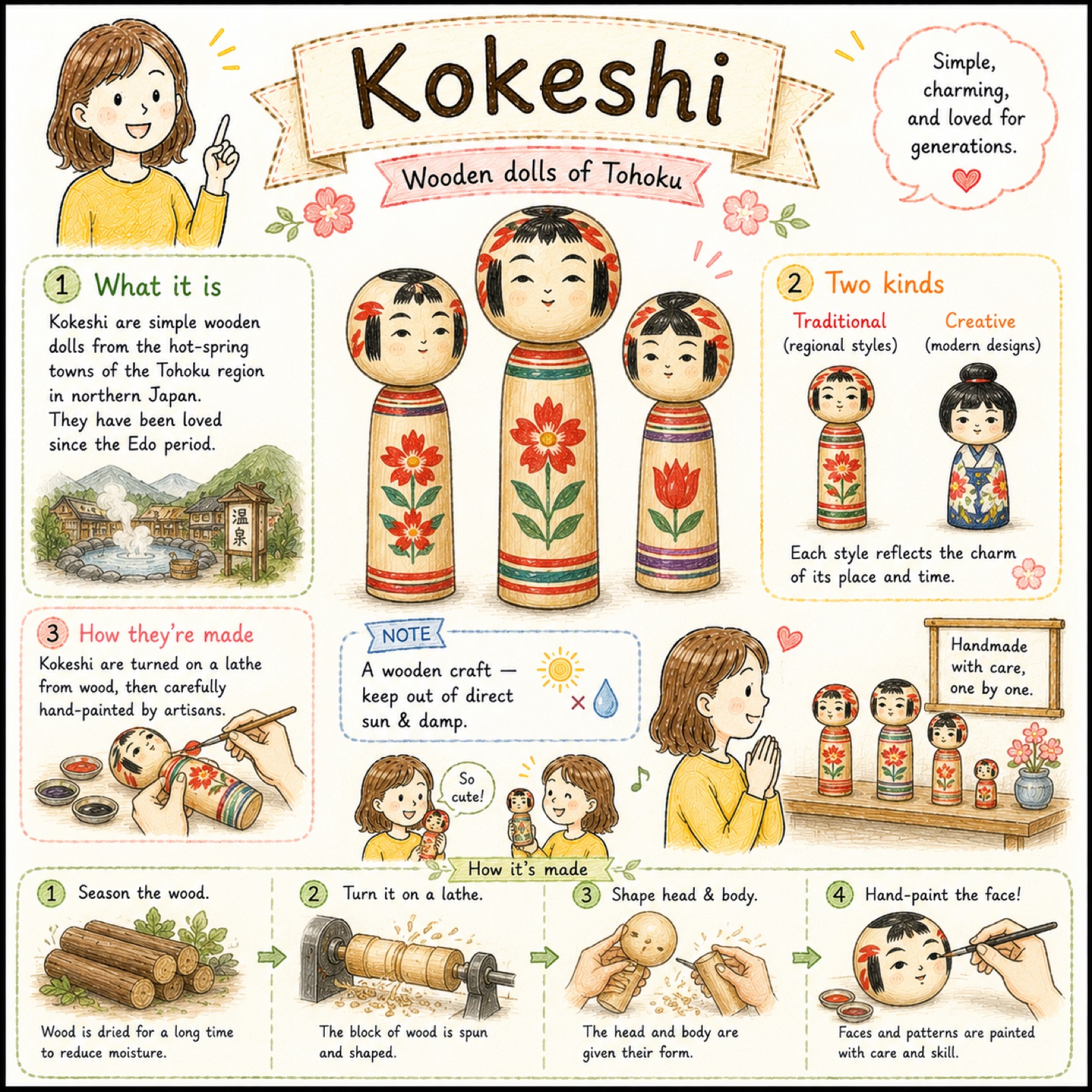
If you’ve ever browsed a souvenir shop in northern Japan and spotted a row of slender wooden dolls — a simple cylindrical body, a round head, no arms or legs, and a calm hand-painted face — you’ve met the kokeshi. These limbless little figures have been turned on a lathe and painted by hand in the hot-spring towns of Tohoku for well over a century, and today they’re as beloved by collectors abroad as they are at home.
A kokeshi isn’t a toy in the modern sense, nor quite an ornament — it sits somewhere warmer in between: a handmade object with a quiet, friendly presence. Here’s what a kokeshi is, the regional families it comes in, how it’s made, and how to choose, display, and care for one.
Why Kokeshi Are Loved
Part of the appeal is simple beauty. A kokeshi reduces a doll to its gentlest essentials — a smooth body, a tilted head, a few brushstrokes for a face — and somehow that restraint is exactly what makes it charming. There’s nothing fussy about it.
Then there’s the regional craft. Each traditional kokeshi belongs to a specific town or hot-spring district in Tohoku, with shapes and patterns passed down from master to apprentice. Hold two dolls side by side and you can often read where each was born from the curve of its body and the flowers on its sleeve.
Finally, kokeshi are wonderfully collectible. With distinct regional families to seek out and endlessly inventive modern designs, you can build a shelf that’s personal to you — a record of the places you’ve visited or the styles that simply make you smile.
The Types of Kokeshi
Kokeshi fall into two broad categories.
- Dento (traditional) kokeshi follow set shapes, proportions, and painted motifs handed down within each producing area. Makers cite eleven recognized regional strains — including Naruko, Togatta, Yajiro, Tsugaru, Yamagata, Sakunami, Tsuchiyu, Hijiori, Zao-Takayu, Nambu, and Kijiyama — each with its own “house style.”
- Sosaku (creative) kokeshi are a newer, freer genre that emerged in the 20th century (the Showa era). Built on the same woodturning skills but unbound by tradition, they explore modern shapes, colors, and themes — anything the artist imagines.
We compare a few of the traditional regional strains in the table below.
| Strain (dento) | Region / Onsen | Distinctive shape & features |
|---|---|---|
| Naruko | Naruko Onsen, Miyagi | Straight body and rounded head; famous for a head that squeaks when twisted; bold floral (often chrysanthemum) motifs. |
| Togatta | Togatta Onsen (Zao), Miyagi | Slightly elongated head, often with a painted hair ornament; slender body decorated with red, green, and black floral patterns. |
| Yajiro | Yajiro (Shiroishi), Miyagi | Among the most colorful strains; wider body and rounder head, with strong reds and yellows in horizontal bands. |
| Tsugaru | Nuruyu / Owani Onsen, Aomori | Slightly tapered body with bold painted lines; colorful seasonal floral designs reflecting the Tsugaru region. |
Sources: JeePe — Kokeshi Dolls Guide: Tohoku Styles; Wikipedia — Kokeshi; The Kokeshi Project — Kokeshi History
What Is a Kokeshi, and How Is It Made?
A kokeshi is a wooden doll with a cylindrical trunk and a separate or integral round head, no arms or legs, finished with a hand-painted face and simple decoration — often floral or striped motifs.
Their roots reach back to around the late Edo period in the Tohoku region of northern Japan. Local woodworkers known as kijiya (木地師), who normally turned bowls and trays on a lathe, began making simple dolls during the quieter winter months to sell to visitors at the area’s hot-spring (onsen) towns. What started as inexpensive souvenirs grew into a refined regional craft.
The making is still rooted in woodturning:
- Choosing and seasoning the wood. Fine-grained woods such as mizuki (dogwood), cherry, and zelkova are favored for their smoothness, then dried so the finished doll won’t crack.
- Turning on the lathe (rokuro). The craftsman mounts a block on a spinning rokuro and, with hand-held tools, shapes the smooth cylindrical body and rounded head from the wood.
- Smoothing and assembling. The surface is sanded clean; depending on the strain, the head is fitted to the body or turned as one piece.
- Hand-painting. Finally the maker paints the face and decoration by hand — the simple features and the floral or striped patterns that mark each regional style.
How to Choose and Display Kokeshi
There’s no single “right” kokeshi — only the one that suits you. A little orientation helps.
Traditional or creative? Decide which spirit appeals to you. Dento (traditional) dolls reward those who love heritage, regional character, and the idea of a form passed down for generations. Sosaku (creative) dolls suit anyone drawn to modern art, bold color, and one-of-a-kind design. Many collectors keep both.
Regional strains to collect. If you go traditional, the regional families are a natural way to focus a collection. Naruko dolls are famous for a head that squeaks when twisted; Togatta dolls have slightly elongated heads and painted floral bodies; Yajiro dolls are bold and colorful with striking bands of red and yellow; Tsugaru dolls tend toward tapered bodies and seasonal floral designs. Collecting a few different strains makes the contrasts come alive.
Where they come from. Authentic kokeshi are still made across Tohoku — in onsen towns and craft workshops — and many areas hold festivals and exhibitions. Buying from a producing region, a reputable craft shop, or directly from a maker is the surest way to get a genuine, well-made piece.
Displaying them. Kokeshi look best grouped on an open shelf, a windowsill set back from the glass, or a small cabinet where their shapes can be seen. A plain background lets the painted faces and patterns stand out, and mixing heights and strains makes a lively, characterful display.
How to Care for a Kokeshi
Kokeshi are made of wood, so a little gentle care keeps them looking their best:
- Keep them out of direct sunlight. Prolonged sun can fade the hand-painted colors over time.
- Avoid humidity and big temperature swings. Damp or rapidly changing conditions aren’t kind to wood; a stable indoor spot is ideal.
- Dust gently. Wipe lightly with a soft, dry cloth or a soft brush. Avoid soaking, harsh cleaners, or scrubbing, which can dull the surface and the paint.
Frequently Asked Questions
What’s the difference between traditional and creative kokeshi?
Traditional (dento) kokeshi follow set shapes and painted patterns tied to a specific Tohoku region and passed down through generations. Creative (sosaku) kokeshi are a 20th-century genre with free, modern designs that aren’t bound to any regional tradition.
Are kokeshi toys or decorations?
Both, historically. The earliest kokeshi were sold as simple souvenirs and playthings in onsen towns, but today they’re collected and displayed mainly as folk-art ornaments rather than toys.
Why do kokeshi from different regions look so different?
Because each of the recognized regional strains developed its own “house style” — distinctive body shapes, head forms, and painted motifs handed down within that town or hot-spring district. Those differences are exactly what collectors enjoy.
What does the name “kokeshi” mean?
Honestly, no one is certain. The origin of the name is debated, and over the years the dolls were written with several different kanji spellings before the hiragana form “こけし” was settled on at a national exhibition around 1940. Various theories exist, but none is universally accepted, so it’s best treated as an open question rather than a settled fact.
How are kokeshi made?
They’re turned from seasoned wood on a lathe called a rokuro, then sanded, assembled, and finished with a hand-painted face and decoration.
A Small Wooden Friend From Tohoku
A kokeshi carries a lot in a very simple form: the snow-country winters of Tohoku, the patient skill of the kijiya at the lathe, and a regional identity painted on in a few sure strokes. Whether you’re drawn to a traditional strain with centuries behind it or a playful modern creation, a kokeshi makes a warm, quietly characterful companion for any shelf — and a piece of northern Japan you can hold in one hand.
About the author
KOBUO is the creator of Kobuo’s Japan Guide, sharing authentic Japanese food, traditions, and crafts with curious readers around the world. Every guide is carefully researched and paired with an original hand-drawn illustration. More about Kobuo →