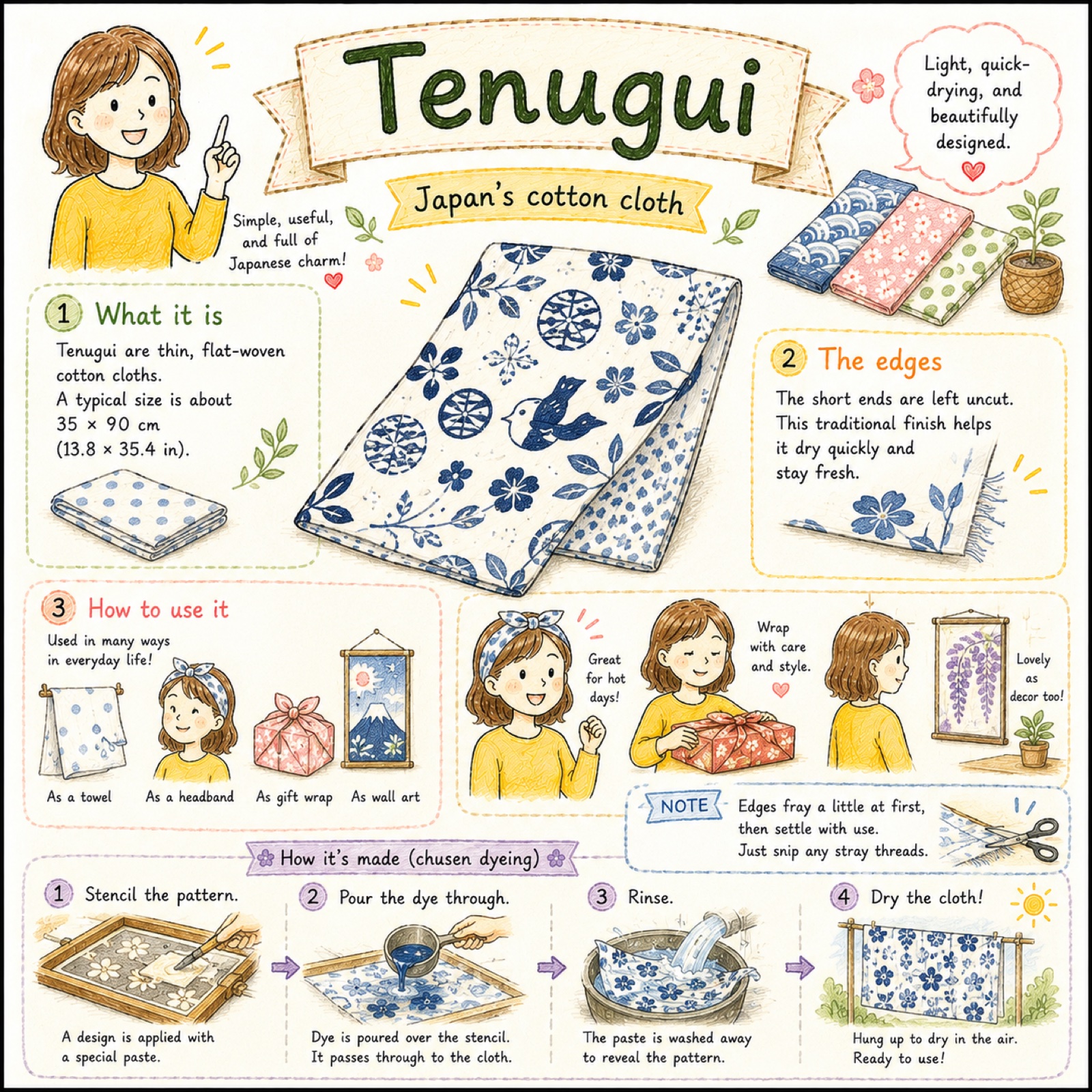
Walk through any Japanese craft shop, festival stall, or kitchen-goods store and you’ll spot them: thin rectangles of cotton, printed with waves, goldfish, cherry blossoms, or bold geometric patterns. This is the tenugui (手ぬぐい) — a flat-woven cotton cloth, usually about 35 × 90 cm, that Japan has been using for centuries. It looks simple. It is anything but. A single tenugui can be a hand towel one moment, a gift wrapper the next, a headband at a festival, and a framed piece of seasonal art on your wall. Here’s what a tenugui is, how the traditional dyeing works, and all the ways you can put one to use.
Why Tenugui Is Loved
Three things make the tenugui quietly indispensable.
First, it is wonderfully versatile. Because it’s just a flat, unstructured piece of cloth, it adapts to whatever you need — drying your hands, wrapping a bottle, covering your head, or carrying a lunch box.
Second, it is quick-drying. Tenugui is woven thin, and (as we’ll see) its short ends are deliberately left unhemmed. With no thick folded seams to trap water, it dries fast and stays fresh — one reason it has outlasted bulkier towels for generations.
Third, it is beautiful. Tenugui carries some of Japan’s most charming textile design, from traditional motifs like seigaiha waves and asanoha hemp leaves to playful modern prints. At a few hundred yen to a couple of thousand yen each, it’s an affordable, foldable, easy-to-pack piece of Japanese craft.
The Types of Tenugui
There are two simple ways to sort tenugui.
By how the pattern is applied, the main split is between chusen (traditional pour-dyeing) and printed tenugui. Chusen cloths show the same design on both faces and have a soft, slightly faded depth that improves with age. Printed tenugui — often made by inkjet or screen printing — can capture fine detail and photographic images, but the pattern usually sits on one side.
By design, you’ll find everything from classic geometric komon patterns and seasonal scenes (cherry blossoms in spring, goldfish in summer, maple leaves in autumn) to humorous and contemporary art. A short comparison table further down breaks down the practical differences.
| Type | Character | Notes |
|---|---|---|
| Chusen (pour-dyed) | Traditional hand pour-dyeing; dye soaks through the cloth, so the pattern looks the same on both faces. Soft texture that deepens with age. | Colors may bleed slightly on the first few washes; gentle hand-washing recommended at first. Each piece is a little unique. |
| Printed | Inkjet or screen printing. Captures fine detail and photographic images; pattern usually sits on one side, with a fainter reverse. | Crisp, vivid, and consistent piece to piece. Often the most affordable option and great for bold, detailed designs. |
| For daily towel use | Thin, flat weave dries fast; unhemmed ends stay breathable and hygienic. | A simple komon (small repeating) pattern hides everyday wear well. |
| For wrapping & carrying | Long, narrow shape knots easily around bottles, bento, and gifts, furoshiki-style. | A reversible chusen cloth looks tidy from every angle when tied. |
| For wall display | Seasonal scenes and bold art shine in a frame or on a hanging rod. | Choose a design clearly meant to be shown; swap it as the seasons change. |
Sources: Kogei Japan (Tokyo Honzome Chusen); Wikipedia (Tenugui); Chidori Japan, Kanno Shoten, and JOC Goods on unhemmed edges and care.
What Is a Tenugui, and How Is It Made?
A tenugui is a length of plain-woven cotton, cut to roughly 35 × 90 cm. The traditional version is colored with a technique called chusen (注染) — literally “pour” (注) and “dye” (染). It has been used since the Meiji era (1868–1912) and remains one of the classic ways to make tenugui. Here is the basic flow:
- Stencil and paste. Long sheets of cotton are stacked in layers, and a rice-based resist paste is applied through a stencil onto the areas that should stay un-dyed.
- Pour the dye. The dyer hand-pours liquid dye onto the stacked cloth from above, while it is drawn through from below. The dye soaks all the way through every layer at once.
- Color both sides. Because the dye permeates the fabric rather than sitting on the surface, the pattern appears the same on both faces — there is no clear “front” and “back.”
- Wash and dry. The paste is washed out and the long cloth is hung to dry, then cut into individual tenugui.
Now, the detail that surprises newcomers: the short ends are left cut and unhemmed, with the threads fraying a little. This is intentional. A folded, sewn hem would trap moisture and dry slowly, which can lead to mildew and odor; an open cut edge breathes and dries quickly, keeping the cloth more hygienic. Historically it was also practical — a tenugui could be quickly torn into strips for a bandage or a tie. The good news is that the fraying isn’t endless: after the first several washes, the loose threads settle and the edge naturally stops shedding. You simply snip any stray strands with scissors along the way.
How to Use a Tenugui
This is where one cloth turns into a dozen tools.
- Everyday towel. The original job. Use it to dry hands and face, or as a thin, fast-drying dish and kitchen cloth.
- Head covering or headband. Folded and tied, a tenugui becomes a hachimaki-style headband, a sweatband for cooking or cleaning, or a simple head wrap.
- Gift wrapping. Wrap a book, a box of sweets, or a small present in a tenugui — the cloth becomes part of the gift.
- Bottle and bento wrap. Knot one around a wine or sake bottle for an instant carry-handle, or wrap a bento box furoshiki-style to keep it together on the go.
- Wall art. Many tenugui are designed to be displayed. Slip one into a simple tenugui frame or hang it on a rod, and swap the design with the seasons.
- Carrying cloth. Used furoshiki-style, a tenugui can bundle up small items, fruit, or odds and ends for a quick trip.
How to Choose and Care for a Tenugui
When choosing, decide whether you want a traditional chusen cloth (soft, double-sided, ages beautifully) or a printed one (crisp detail, vivid images). For wall display, look for a design clearly meant to be shown; for daily use, a simple komon pattern hides wear well.
For care, a little patience pays off:
- The cut ends will fray at first. This is normal. Just trim stray threads with scissors; the edge settles after several washes and stops shedding.
- Color may bleed at first. With chusen tenugui especially, the dye can run a little early on. Hand-wash it on its own (or with like colors) in lukewarm water for the first few washes, without strong detergent, and keep it separate from other laundry.
- Dry in the shade. Smooth out wrinkles by hand and hang it to dry away from direct sun to keep the colors rich. The thin weave dries quickly.
Treated this way, a tenugui only gets softer and more characterful with time.
Frequently Asked Questions
Why are the ends of a tenugui not hemmed?
So the cloth dries quickly and stays hygienic. A sewn hem traps moisture and dries slowly, which can invite mildew; an open cut edge breathes. Historically, unhemmed ends also let people tear the cloth into strips for bandages or ties.
How do I stop the edges from fraying?
You don’t need to do anything drastic. The cut edge frays only a little at first, then naturally stops after several washes as the weave tightens. Simply snip off any loose stray threads with scissors as they appear.
Will the colors run when I wash it?
They may bleed slightly at first, especially with traditional chusen-dyed tenugui. Hand-wash it separately in lukewarm water for the first few washes, avoid strong detergent, and dry it in the shade. The bleeding settles down with use.
How do I display a tenugui as wall art?
Use a dedicated tenugui frame or a thin hanging rod made for the standard size, or clip it to a simple bar. Because many designs are seasonal, displaying tenugui is a popular, low-cost way to change a room’s mood through the year.
Is a tenugui the same as a furoshiki?
No, though their uses overlap. A furoshiki is a square wrapping cloth, while a tenugui is a long, narrow towel-cloth. You can wrap things furoshiki-style with a tenugui, but a true furoshiki is square and often made of heavier fabric.
One Cloth, Endless Uses
A tenugui asks almost nothing of you — a few hundred yen, a little space in your bag — and gives back a small, useful piece of everyday Japan. Dry your hands with it, wrap a gift in it, tie back your hair, or frame it on the wall and watch the seasons turn. Pick one whose pattern makes you smile, give it a gentle first wash, and let it fray, soften, and fade into something that feels entirely your own.
About the author
KOBUO is the creator of Kobuo’s Japan Guide, sharing authentic Japanese food, traditions, and crafts with curious readers around the world. Every guide is carefully researched and paired with an original hand-drawn illustration. More about Kobuo →