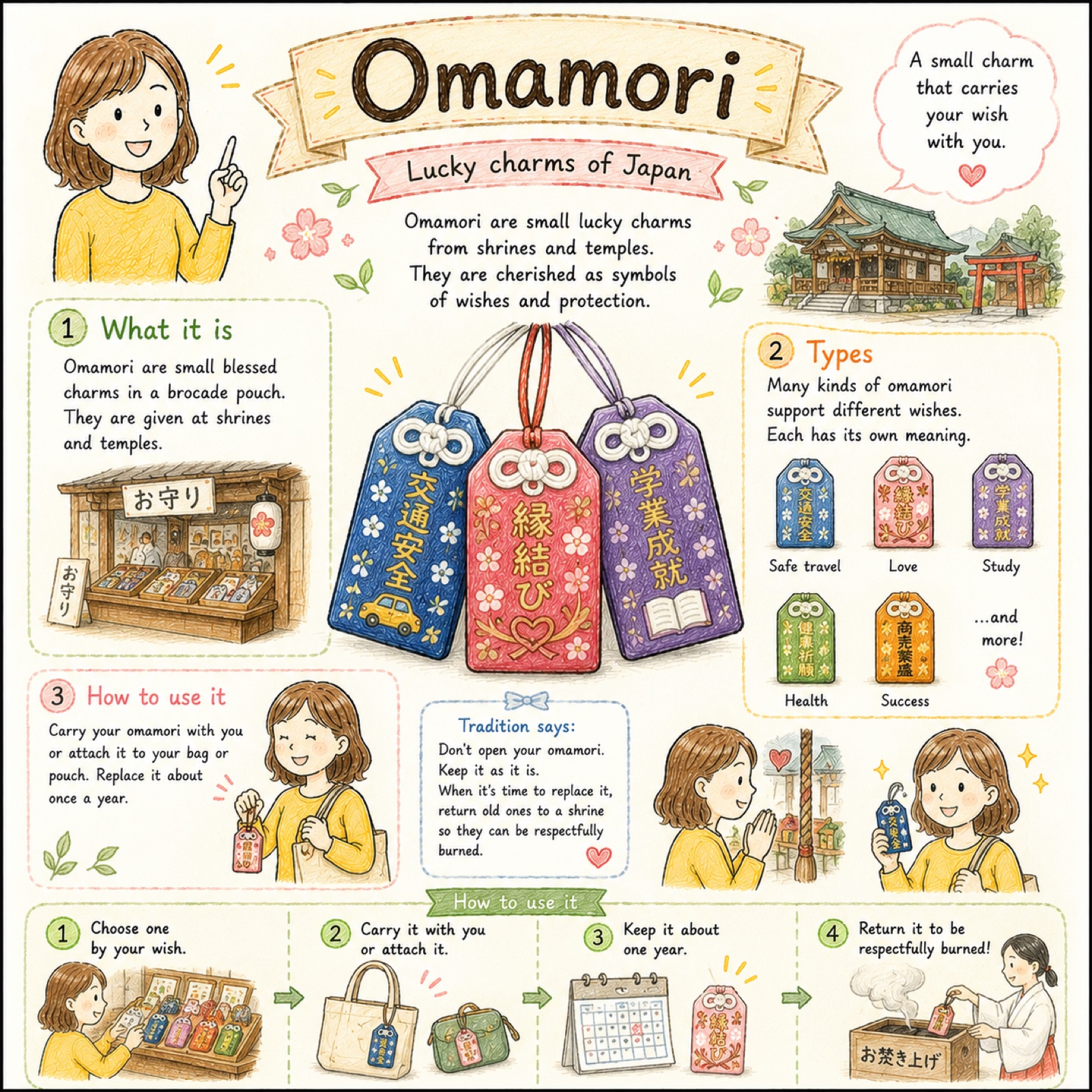
Wander into almost any shrine or temple in Japan and you’ll find a small counter lined with colorful little pouches — silk and brocade in every shade, each one tied with a neat cord. These are omamori (お守り), Japan’s beloved amulets. Travelers pick them up as keepsakes, but to the people who carry them they are something warmer: a small, tactile way of carrying a wish — for safe travels, for love, for a passed exam — wherever you go. Here’s what they are, the types you’ll see, and how to use one respectfully.
What an Omamori Is For
The word omamori comes from the Japanese verb mamoru, meaning “to protect.” At heart, an omamori is a portable wish. People carry one because it is traditionally believed to invite a particular kind of good fortune — and because it keeps that hope close, in a pocket or on a bag, all year long.
You’ll often see omamori carried alongside other shrine and temple customs, much like collecting goshuin stamp books. One is a record of where you’ve been; the other is a small companion for where you’re going. Both are easy, welcoming ways for a visitor to take part.
The Types of Omamori
What makes omamori so charming is that there’s one for almost every wish. Each is dedicated to a specific purpose, usually printed right on the pouch in Japanese. The most common types you’ll encounter are:
- Kotsu-anzen (交通安全) — traffic and travel safety
- En-musubi (縁結び) — love, marriage, and good relationships
- Gakugyo-joju (学業成就) — study and exam success
- Shobai-hanjo (商売繁盛) — business and financial prosperity
- Kenko / Byoki-heiyu (健康・病気平癒) — carried by people hoping for good health or recovery
- Anzan (安産) — a safe and easy childbirth
- Yaku-yoke (厄除け) — warding off misfortune and bad luck
- Kaiun (開運) — general good fortune
You’ll find a quick comparison of the most common types in the table below.
| Type (Japanese) | Purpose | Who tends to get it |
|---|---|---|
| Kotsu-anzen (交通安全) | Traffic & travel safety | Drivers, commuters, travelers |
| En-musubi (縁結び) | Love, marriage & good relationships | Singles, couples, anyone hoping for a good match |
| Gakugyo-joju (学業成就) | Study & exam success | Students; parents buying for children |
| Shobai-hanjo (商売繁盛) | Business & financial prosperity | Shop owners, businesspeople, the self-employed |
| Kenko / Byoki-heiyu (健康・病気平癒) | Carried while traditionally hoping for good health or recovery | Those wishing wellness for themselves or loved ones |
| Anzan (安産) | Hope for a safe, easy childbirth | Expectant mothers and their families |
| Yaku-yoke (厄除け) | Warding off misfortune & bad luck | People in an unlucky year (yakudoshi) or seeking peace of mind |
| Kaiun (開運) | General good fortune | Anyone wishing for all-round good luck |
Sources: Nippon.com (“Omamori: Lucky Amulets for All Occasions”); Wikipedia (“Omamori”); Tofugu; Savvy Tokyo. Purposes and customs reflect widely held cultural belief and traditional practice.
What Is an Omamori, and How Does It Work?
An omamori is a small brocade or cloth pouch that holds a blessed inner talisman — a slip of paper or a thin piece of wood, inscribed at the shrine or temple with sacred words, the name of the place, or the name of an enshrined deity or Buddha. Through that blessing, the charm is said to carry a deity’s protection or goodwill to whoever keeps it.
You can buy omamori at both Shinto shrines and Buddhist temples — they are a shared custom across both traditions, so you’ll see them wherever you go. A typical one costs around ¥500 to ¥1,000, and famous spots often sell exclusive designs you won’t find anywhere else.
One rule matters more than any other: never open the pouch. Tradition holds that the blessing is sealed inside, and that opening it is believed to release — and so void — the protection it carries. Resist the urge to peek; part of the charm’s meaning is that it stays closed.
How to Use and Carry an Omamori
Omamori are meant to be kept close, not tucked away in a drawer. The general idea is simple: carry it with you, or attach it somewhere it can travel alongside the thing you’re wishing for.
Where to attach it, by purpose:
- Kotsu-anzen — hang it in your car or clip it to a bicycle, suitcase, or travel bag.
- Gakugyo-joju — tuck it into a pencil case, school bag, or pocket before an exam.
- En-musubi — many people keep it in a wallet, phone case, or favorite bag.
- Shobai-hanjo — often kept in a wallet, by the register, or in a work bag.
- General types — clip it to a daypack, attach it to your phone, or simply carry it on you.
How to treat it. An omamori is a small sacred object, so handle it with a little care — keep it somewhere clean rather than crumpled at the bottom of a bag, and don’t toss it around. There’s no need to be precious about it; ordinary respectful handling is all that’s expected.
Replacing it each year. Traditionally, omamori are refreshed about once a year. Many people return their old charm and receive a new one during hatsumode, the first shrine or temple visit of the New Year. The idea is one of gratitude: the old amulet has carried your wish through the year, and a fresh one carries it into the next.
Returning the old one. When you’re done with an omamori, the respectful thing is not to throw it in the trash. Instead, bring it back to a shrine or temple — ideally the one it came from, though many sites accept any. Most have a designated drop-off box (osame-sho), where old charms are gathered and ceremonially burned, often in a year-end or New Year ritual, as a way of giving thanks. If you’ve taken one home overseas and can’t return it, doing so with the same spirit of gratitude is what counts.
Can you give one as a gift? Yes — and it’s a lovely gesture. Choosing an omamori for a friend’s safe travels, a student’s exams, or a loved one’s wish is a thoughtful, very Japanese way to say I’m thinking of you. Just remember that the recipient shouldn’t open it either.
How to Choose an Omamori
Start with the wish, not the look. Decide what you (or the person you’re buying for) most want to carry — safe travels, success, a good relationship — and find the matching type at the counter. If you’re unsure which is which, staff are used to helping visitors, and the purpose is usually printed on the pouch.
Beyond purpose, it’s perfectly fine to choose by beauty and meaning. Many shrines and temples sell designs tied to their location, their season, or a particular deity, so an omamori can double as a keepsake of a place you loved. A charm from a spot you genuinely visited and enjoyed will always feel more meaningful than one bought at random.
Frequently Asked Questions
Can I open my omamori to see what’s inside?
It’s best not to. Tradition holds that the blessing is sealed inside the pouch, and opening it is believed to release and void the charm’s protection. Part of an omamori’s meaning is that it stays closed — so enjoy the mystery and leave it sealed.
When should I replace an omamori?
About once a year is the custom. Many people return the old one and pick up a fresh charm during their first shrine or temple visit of the New Year, as a gesture of thanks for the year that’s passed.
What should I do with an old omamori?
Don’t throw it in the trash. Bring it back to a shrine or temple — ideally where you got it — and place it in the amulet return box, where old charms are gathered and ceremonially burned with gratitude. If you live overseas, returning it on a future trip, or simply parting with it respectfully, is what matters.
Can foreigners or non-religious people carry an omamori?
Absolutely. Like receiving a goshuin, carrying an omamori is open to everyone — Japanese or foreign, religious or simply curious. Most people treat it as a warm cultural custom and a small token of hope, and visitors are very welcome to take part.
Is an omamori a good souvenir or gift?
It’s one of the nicest you can bring home. It’s small, light, meaningful, and tied to a specific place — and choosing one for someone else, matched to their wish, is a heartfelt gesture. Just remind them not to open it.
A Small Wish You Can Carry
An omamori is one of the gentlest traditions in Japan: a tiny pouch that turns a hope into something you can hold. Pick one up at a shrine or temple you’ve enjoyed — perhaps on the same visit you receive a goshuin — and let it travel with you. Keep it close, treat it kindly, and when the year turns, return it with thanks. It’s a small, beautiful way to carry a little of Japan with you wherever you go.
About the author
KOBUO is the creator of Kobuo’s Japan Guide, sharing authentic Japanese food, traditions, and crafts with curious readers around the world. Every guide is carefully researched and paired with an original hand-drawn illustration. More about Kobuo →