If you visit a shrine or temple in Japan and notice people handing over a beautiful folding book to a calligrapher — then walking away with a striking work of red and black art inside — you’ve just witnessed one of the country’s most rewarding travel traditions: collecting goshuin.
A goshuin is part stamp, part calligraphy, and entirely unique to the place you received it. Collected in a special book called a goshuincho, they become a personal, hand-made record of your journey through Japan — far more meaningful than a fridge magnet. Here’s everything a first-time visitor needs to know: what they are, how to get one respectfully, and how to choose the right book.
What Is a Goshuin?
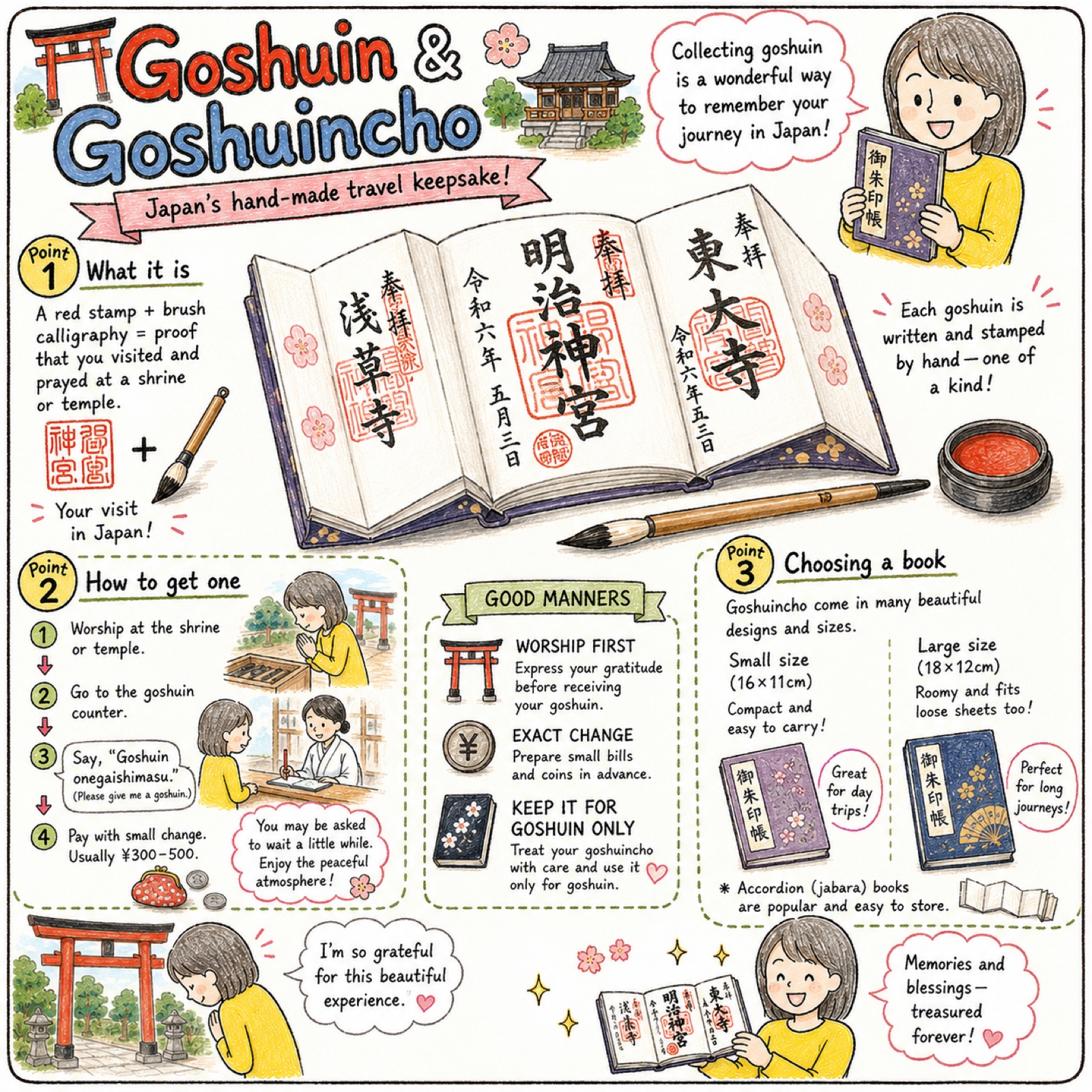
A goshuin (御朱印) is a seal you receive at a shrine or temple as proof that you have visited and paid your respects. A typical goshuin combines:
- One or more red vermilion stamps — the seals of the shrine or temple
- Hand-brushed calligraphy in black ink — usually the name of the place, the date of your visit, and sometimes the name of the enshrined deity or Buddha
Because the calligraphy is written by hand, every goshuin is slightly different — even at the same location. Originally, goshuin were given to pilgrims as a receipt for copying and offering sutras. Today, anyone is welcome to receive one: Japanese or foreign, religious or simply curious. A standard goshuin usually costs ¥300–¥500, with special or seasonal designs running ¥500–¥1,000 or more.
What Is a Goshuincho?
A goshuincho (御朱印帳) is the book you collect your goshuin in. It’s not an ordinary notebook: it’s made from thick washi (Japanese paper) folded in an accordion — or “jabara” — style, so the heavy ink and stamps won’t bleed through to the other side. Once it’s full, you can stretch the whole thing out into one long, continuous scroll of your travels.
In most cases, you’ll need a goshuincho to receive a goshuin — the calligrapher writes directly onto a blank page of your book. (There’s one exception, “kakioki,” covered below.) You can buy one at almost any larger shrine or temple, or bring your own from home so you’re ready from your very first visit.
How to Receive a Goshuin: Step by Step
The single most important thing to understand is that a goshuin is proof of worship, not a tourist stamp. The etiquette flows from that idea:
- Worship first. Before anything else, go to the main hall and pay your respects properly. At a shrine, the common form is: bow once, offer a coin, bow twice, clap twice, pray, then bow once more. The goshuin comes after your visit — never instead of it.
- Find the counter. Look for the goshuin desk, often labeled 授与所 (juyosho) at shrines or 納経所 (nokyosho) at temples.
- Ask politely. Hand over your goshuincho opened to a blank page and say “Goshuin onegaishimasu” (ご朱印お願いします — “A goshuin, please”). A small bow goes a long way.
- Wait quietly. The calligrapher is making something by hand. Watch respectfully and don’t rush them.
- Pay with small change. The fee — usually ¥300–¥500 — is best paid with exact change, so carry ¥100 coins rather than asking a sacred site to break a ¥10,000 note.
Etiquette and Respect: A Few Things to Keep in Mind
- It’s a spiritual act, not a collecting game. Receive each goshuin at a place you’ve genuinely visited and respected.
- Keep your goshuincho for goshuin only — not as a regular notebook or autograph book.
- “Kakioki” (書き置き). When a site is very busy, or has no calligrapher that day, you may receive a pre-written goshuin on a loose sheet of paper instead. This is completely normal — you simply glue it into your book later. Standard and large books are sized to fit these sheets.
- Photography varies. Some places don’t allow photos of the calligrapher at work. Watch for signs, or simply ask first.
- Be patient at popular spots. Famous temples can have long goshuin queues, especially on weekends and during seasonal events.
Shrine or Temple: Should You Keep Separate Books?
This is the question every collector eventually asks. Shrines (Shinto) and temples (Buddhist) belong to different religious traditions, and there’s a historical reason some people are careful: a Meiji-era (1868–1912) policy formally separated Shinto and Buddhism.
The practical reality today:
- There is no strict rule that shrine and temple goshuin must go in separate books, and plenty of people happily mix them.
- However, many collectors prefer two books — one for shrines, one for temples — and a small number of temples (particularly of the Nichiren sect) may decline to write in a book that already contains shrine stamps.
Simple advice for visitors: if you want zero friction, consider carrying two goshuincho — one for shrines and one for temples. If you’d rather keep it simple with a single book, that’s perfectly fine too; just be aware that, on rare occasions, a temple might politely decline.
How to Choose a Goshuincho
Here’s where a little knowledge saves you some regret. Goshuincho vary in size, binding, and cover — and the “right” one depends on how you plan to use it.
Size: Small (小判) vs. Large (大判)
- **Small / koban — about 16 × 11 cm. Compact and easy to carry, this is the size you’ll most often see at shrines**. Pros: light, pocketable, classic. Cons: pre-written kakioki sheets may need folding to fit.
- **Large / ōban — about 18 × 12 cm. Roomier, increasingly popular, and common at temples**. Pros: bold calligraphy has space to breathe, and kakioki sheets fit without folding. Cons: bulkier in a day bag.
If you expect to collect a lot of kakioki, lean large. If you prize portability and mostly visit shrines, small is timeless.
| Size | Dimensions | Best for | Often seen at |
|---|---|---|---|
| Small (koban) | about 16 × 11 cm | Portability, day trips | Shrines |
| Large (ōban) | about 18 × 12 cm | Roomy calligraphy; fits loose sheets unfolded | Temples |
Binding and Paper
The traditional build is the accordion (jabara) fold in washi paper — choose this. The thick paper is what stops ink from bleeding through, so avoid thin, ordinary-paper books sold purely as souvenirs.
Cover
- Fabric covers — often Nishijin-ori brocade or yuzen patterns — are beautiful and durable, and make a popular gift.
- Washi or printed-design covers are lighter and often feature a specific shrine, temple, or piece of seasonal art.
Where to Buy
- At shrines and temples. Many sell their own exclusive designs — a lovely keepsake tied to a specific place.
- Online, before your trip. Buying a goshuincho in advance means you can start collecting from your very first stop, instead of spending your first temple visit shopping for a book. Look for an authentic accordion-fold washi book in your preferred size.
Quick Tips for First-Timers
- Start with one good book, and add a second if you decide to separate shrines and temples.
- Always carry ¥100 coins.
- Note the dates of your visits so your book doubles as a travel diary.
- Don’t be shy — staff are used to visitors, and a polite “onegaishimasu” is all you need.
Frequently Asked Questions
Can foreigners receive a goshuin?
Yes. Anyone is welcome to receive a goshuin — Japanese or foreign, religious or simply curious. The main thing is to visit respectfully and to worship before you go to the counter.
How much does a goshuin cost?
A standard goshuin usually costs about ¥300–¥500, with special or seasonal designs running ¥500–¥1,000 or more. Bring small coins so you can pay with exact change.
Do I need a goshuincho to get a goshuin?
Usually, yes — the calligrapher writes directly into your book. If you don’t have one, you can buy a goshuincho at most larger shrines and temples, or bring one from home. When a site is very busy or has no calligrapher that day, you may instead receive a pre-written goshuin on a loose sheet (kakioki) to glue in later.
Should I keep shrine and temple goshuin in separate books?
There’s no strict rule, and many people mix them. However, some collectors prefer separate books — one for shrines, one for temples — and a small number of temples may decline to write in a book that already contains shrine stamps. If you’d like zero friction, carrying two books is the safe option.
What size goshuincho should I choose?
The small size (about 16 × 11 cm) is compact and easy to carry, and is common at shrines. The large size (about 18 × 12 cm) is roomier and fits pre-written sheets without folding — handy if you expect to collect a lot of kakioki.
A Hand-Made Record of Your Journey
A wall of photos fades into your camera roll. A goshuincho is different: a tactile, hand-brushed, one-of-a-kind chronicle of the places you stood, the gates you walked through, and the moments you paused to pay respect. Pick up a book before your trip — or at your first shrine — and let your journey through Japan write itself, one beautiful page at a time.
About the author
KOBUO is the creator of Kobuo’s Japan Guide, sharing authentic Japanese food, traditions, and crafts with curious readers around the world. Every guide is carefully researched and paired with an original hand-drawn illustration. More about Kobuo →