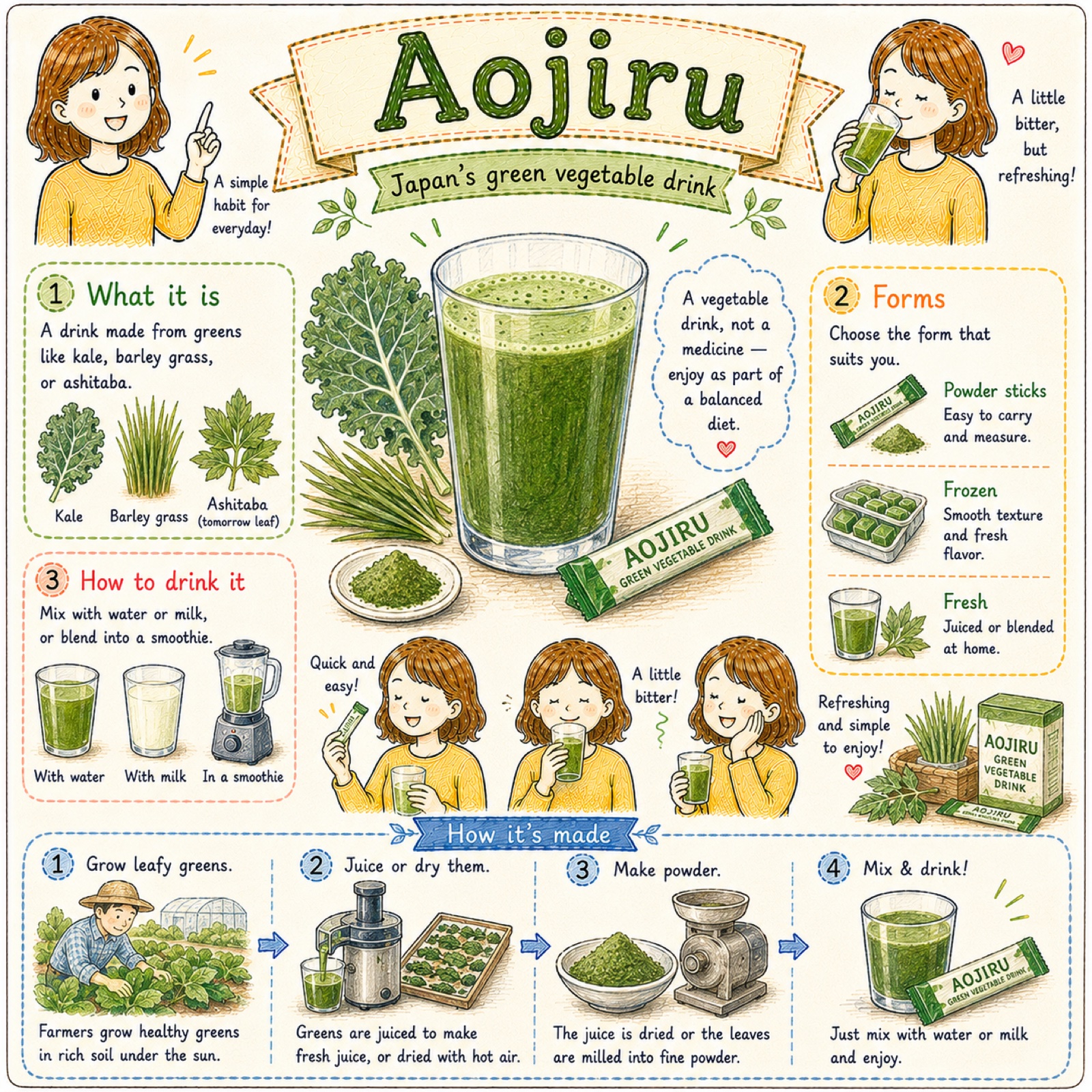
If you’ve spent time in Japan, you’ve probably seen it: a glass of vivid green liquid, or a row of single-serving powder sticks at the drugstore, all labeled aojiru. The name simply means “green juice,” and that’s exactly what it is — a drink made from leafy green vegetables. It has a reputation for being good-for-you and, famously, a little bitter. This guide explains what aojiru actually is, the main vegetables it’s made from, how people drink it, and a few honest things to keep in mind before you try it.
Why Aojiru Is Popular
Most of us know we should eat more vegetables, and most of us don’t manage as many as we’d like. Aojiru’s appeal is squarely practical: it’s a convenient way to add some green vegetables to your day when cooking a salad isn’t going to happen.
- It’s quick and portable. A stick of powder mixes into water in seconds, which makes it easy to fit into a busy morning or pack in a bag.
- It contains nutrients from leafy greens. Depending on the base vegetable, aojiru contains things like dietary fiber, vitamins, and minerals such as potassium — the kinds of nutrients you’d expect from kale or barley grass.
- It’s a low-effort way to add vegetables. For people who struggle to eat enough greens, a daily glass is an easy, repeatable habit.
One honest note. Aojiru is a vegetable drink — not a medicine, and not a substitute for actually eating vegetables and a balanced diet. It can be genuinely bitter, depending on the base ingredient. And there are two groups who should be careful: because leafy greens are naturally high in vitamin K, anyone taking blood thinners such as warfarin should talk to their doctor first, since vitamin K affects how those medications work. Likewise, because green vegetables are a source of potassium (and some contain oxalates), people with kidney conditions or anyone on medication should check with a doctor before drinking it regularly. Enjoy aojiru as a convenient extra, not a cure-all.
The Types of Aojiru
Aojiru is named for its color, not a single recipe, so what’s actually in the glass depends on the base vegetable. The most common ones are kale, young barley grass (also called barley grass), ashitaba, and komatsuna. Each has its own taste and character, which is why two cups of aojiru can taste quite different. The table later in this guide compares them side by side.
| Base ingredient | Taste | Character | Notes |
|---|---|---|---|
| Kale | Rich, fairly bitter and grassy | The classic aojiru base; bold, full-flavored green | A leafy green that contains fiber, vitamins, and minerals; the strongest-tasting of the common bases |
| Barley grass (young barley leaves) | Milder, lighter and more grassy-sweet | Smooth and approachable; a common pick for first-timers | Often used in fruit blends; generally easier to drink than kale |
| Ashitaba | Distinct, herbal and slightly bitter | A more unusual, characterful green native to Japan | A traditional leafy vegetable; flavor is more pronounced than barley grass |
| Komatsuna (Japanese mustard spinach) | Relatively gentle and mild | Soft, leafy and easygoing | A familiar Japanese leafy green; often blended with other bases |
Sources: Wikipedia, “Aojiru”; Japanese Taste, “Aojiru: The Japanese Green Juice”; LIVE JAPAN, “Beauty Journalist Shares All About ‘Aojiru’.”
What Is Aojiru, and How Is It Made?
Aojiru is, at heart, the juice or finely milled powder of leafy green vegetables. The first version is usually credited to a Japanese army doctor in the 1940s, who juiced the discarded outer leaves of vegetables to add greens to a lean wartime diet. Today it’s a mainstream health drink sold in several forms. In simple terms, here’s how a typical powdered aojiru comes to be:
- Grow and harvest the base vegetable — most often kale or young barley grass.
- Wash and process the leaves, then juice or finely grind them.
- Dry the result into a powder (or freeze it, for frozen and fresh-style products).
- Portion it into single-serving sticks, tablets, or pouches ready to mix with liquid.
You’ll mainly find aojiru as powder (the most common, in stick packets), as well as frozen, tablet, and occasionally fresh forms. Powder is popular simply because it keeps well and travels easily.
How to Drink Aojiru
The classic way is to stir a stick of powder into a glass of cold water and drink it. But because plain aojiru can taste grassy or bitter, most people find ways to soften it:
- With water. The simplest method. Cold water tends to taste cleaner than warm.
- With milk or soy milk. Dairy or soy milk rounds out the bitterness and adds a creamier body — a very common pairing.
- In a smoothie. Blend it with banana, apple, or other fruit to mask the green edge and make a more substantial drink.
- Stirred into yogurt. A spoonful of aojiru powder into plain yogurt turns it into a snack rather than a drink.
A few tips to reduce bitterness: mix it with something naturally sweet (fruit, a little honey, or milk), serve it cold, and start with a kale- or barley-based product, which many people find more approachable. If a brand is too strong for you, try a fruit-blended version designed for first-timers.
How to Choose and Store Aojiru
- Pick a base you’ll actually drink. If you’re new to it, a barley grass or kale-and-fruit blend is usually milder than a pure, single-vegetable powder.
- Check the form. Powder sticks are the most convenient and shelf-stable; frozen and fresh types can taste closer to real juice but need freezer or fridge space.
- Read the label. Look at the base vegetable and the serving size, and note any added sugar or flavoring if you’d rather keep it simple.
- Store it dry. Keep powder sealed and away from humidity, and use frozen products from the freezer as directed. Mix powder fresh each time rather than letting a made-up glass sit.
Frequently Asked Questions
Does aojiru taste bad?
It has a reputation for being bitter, and pure single-vegetable versions can be grassy and strong. That said, modern blends are much milder, and mixing aojiru with milk, soy milk, or fruit in a smoothie makes it easy to drink. Many people get used to the taste quickly.
Can I drink aojiru every day?
Many people in Japan do drink it daily as a convenient way to add some greens. As with any food or drink, it’s best treated as part of a balanced diet rather than a replacement for eating vegetables. If you take medication or have a health condition, see the caution below.
Who should be cautious about drinking aojiru?
Because leafy greens are high in vitamin K, anyone on blood thinners such as warfarin should check with their doctor first. People with kidney conditions (greens are a source of potassium) or anyone on medication should also consult a healthcare professional before drinking it regularly.
Is aojiru a meal replacement?
No. Aojiru is a vegetable drink, not a meal and not a substitute for eating real vegetables. Think of it as a small, convenient addition to an otherwise balanced diet.
What’s the difference between the types?
The main difference is the base vegetable. Kale tends to be rich and strong, barley grass is milder and more approachable, ashitaba has a distinct herbal character, and komatsuna is relatively gentle. The comparison table above breaks down each one.
A Simple Glass of Greens
Aojiru isn’t magic, and it was never meant to be — it’s a straightforward, convenient way to fold a little more green into a busy day. If you’ve struggled to eat as many vegetables as you’d like, a cold glass of aojiru (with a splash of milk or a handful of fruit, if the bitterness isn’t your thing) is an easy habit to build. Treat it as a helpful extra alongside real food, check with your doctor if you’re on medication, and you’ll see why this humble green drink has stayed on Japanese tables for generations.
About the author
KOBUO is the creator of Kobuo’s Japan Guide, sharing authentic Japanese food, traditions, and crafts with curious readers around the world. Every guide is carefully researched and paired with an original hand-drawn illustration. More about Kobuo →