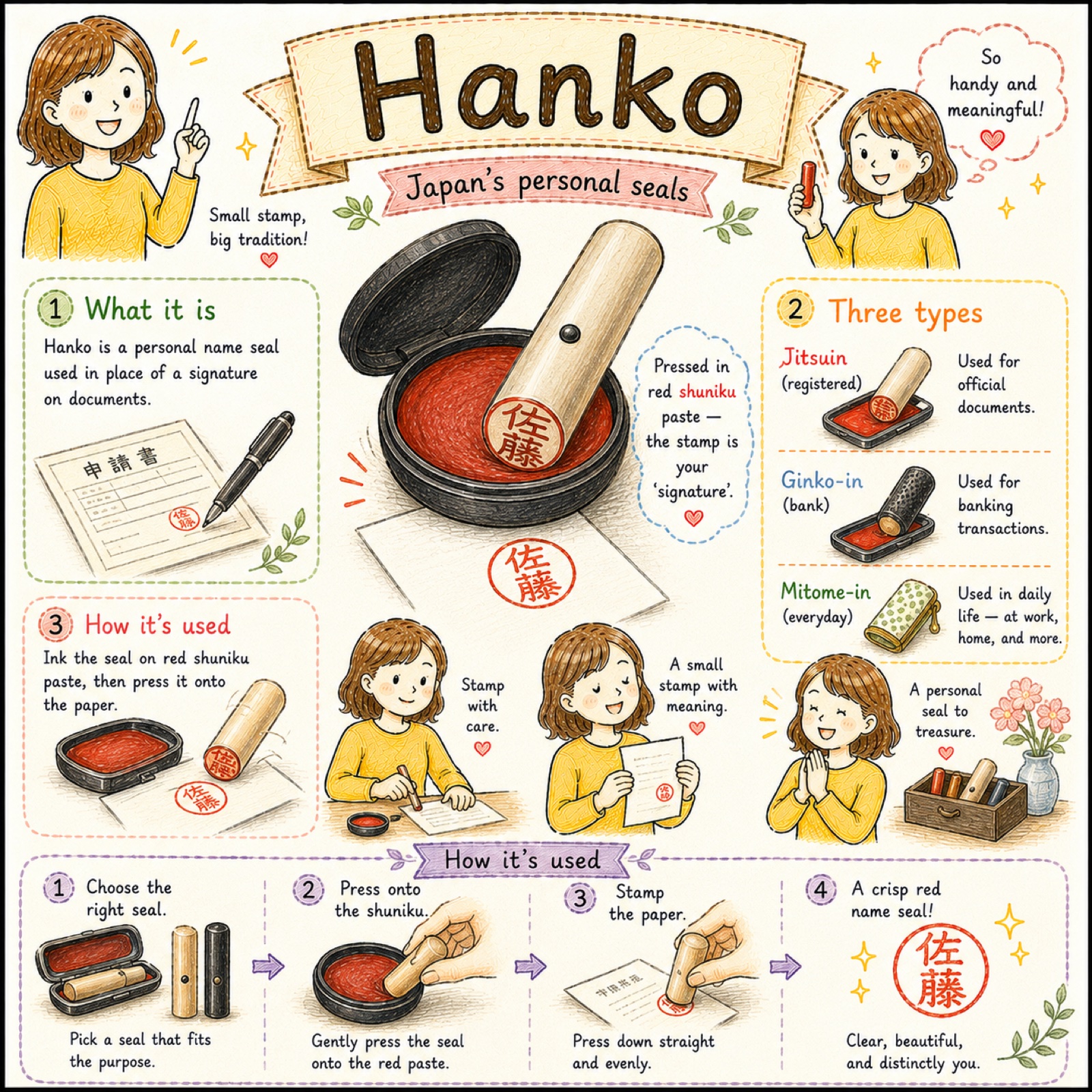
Open a drawer in almost any Japanese home and you’ll find a small cylindrical stamp, often tucked into a slim protective case. Press its carved end into a pad of red paste, roll it onto paper, and you’ve just done something that, in much of Japan, carries the weight of a handwritten signature. This is the hanko — a personal seal that has stamped its way through centuries of Japanese life, from imperial decrees to today’s parcel deliveries. Here’s what a hanko is, the three types you’ll encounter, and how each one is actually used.
Why Japan Uses Hanko
In many countries, you sign your name to agree to something. In Japan, you have traditionally pressed a seal instead. The red impression of a hanko stands in for your signature on everything from a delivery receipt to a property contract, and it carries real legal and social meaning: it says I have seen this, and I agree.
The custom is old — seals arrived from China over a thousand years ago and were once reserved for emperors and powerful officials. Over time they spread to ordinary people, and by the modern era nearly every adult owned at least one. The practice became woven into how contracts are signed, accounts are opened, and offices keep their paperwork moving. Even as digital alternatives spread (more on that below), the hanko remains a quietly important part of daily Japanese life.
The Types of Hanko
Not all hanko are equal. Three main types are defined by how official they are and what they’re used for:
- Jitsuin (実印) — your officially registered seal, used for the biggest, most legally serious moments.
- Ginko-in (銀行印) — the seal registered with your bank for financial transactions.
- Mitome-in (認印) — an everyday, unregistered seal for routine paperwork.
Most people in Japan own all three, often using a different physical seal for each so that the important ones aren’t easily copied. We compare them side by side below.
| Seal type | Registered? | Used for | Formality |
|---|---|---|---|
| Jitsuin (実印) | Yes — registered with your local city/ward office (comes with a certificate) | Major contracts: buying property or a car, loans, setting up a company, wills and inheritance | Highest — equivalent to a legal signature |
| Ginko-in (銀行印) | Yes — registered with your bank when you open an account | Banking: large withdrawals, account changes, other financial transactions | High — for financial matters only |
| Mitome-in (認印) | No — unregistered | Everyday tasks: parcel deliveries, internal company documents, routine forms | Everyday — no special legal standing |
Sources: Japan Living Guide; Selectra Japan (inkan registration); AQ Partners (Japan inkan system); Aikagi (hanko for foreigners).
What Is a Hanko, and How Is It Used?
First, a useful piece of vocabulary. You’ll hear two words — hanko and inkan — used interchangeably in everyday speech. Strictly speaking, the hanko is the physical object (the carved stamp you hold), while the inkan is the impression it leaves on paper, and inkan tends to be the more formal, legal-sounding term. In casual conversation, though, most people use either word to mean “the seal,” and you’ll rarely be misunderstood whichever you choose.
The impression itself is usually round and carries your family name (sometimes your given name or full name), carved in stylized characters. To make it, you don’t use an ink pad but a small pot of thick red paste called shuniku (朱肉). Vermilion has been used for seal impressions for centuries because it stands out clearly against black ink and resists fading.
Using a hanko is simple, but there’s a small technique to a clean impression:
- Open your shuniku and gently tap the carved face of the seal onto the paste — a light, even coating, not a heavy one.
- Place a sheet of paper on a slightly soft surface (a desk pad or a few extra sheets underneath help the seal print evenly).
- Press straight down onto the spot, applying gentle, even pressure and a tiny rocking motion so every part of the seal makes contact.
- Lift straight up to reveal a crisp red impression — your inkan.
When You Need Each Type
This is where the three types really matter, because Japan treats them very differently.
Jitsuin (実印) — the registered seal. A jitsuin is a seal you have formally registered with your local city or ward office, which issues a matching certificate (inkan shomeisho) proving the seal is genuinely yours. Because of that registration, the jitsuin is reserved for life’s most important paperwork: buying property or a car, taking out a loan, setting up a company, notarized documents, and inheritance or wills. Anyone aged 15 or older can register one, and each person may register only a single jitsuin. For this reason, people choose a distinctive, well-made seal for their jitsuin and keep it somewhere safe.
Ginko-in (銀行印) — the bank seal. When you open a bank account, you register a seal with that bank; this becomes your ginko-in, used to authorize transactions such as large withdrawals or changes to your account. It’s widely advised to make your ginko-in a different physical seal from your jitsuin, so that losing or copying one doesn’t compromise the other.
Mitome-in (認印) — the everyday seal. The mitome-in is an ordinary, unregistered seal for daily life: acknowledging a parcel delivery, signing off on internal company documents, or filling in routine forms. It has no special legal standing and is the seal most people reach for most often. Inexpensive, mass-produced versions are sold everywhere — though common Japanese surnames are easy to find, which is one reason such seals aren’t trusted for anything serious.
Getting one made. You can buy a ready-made mitome-in for a common surname at a hundred-yen shop or stationery store, while jitsuin and ginko-in are usually custom-carved at a seal shop (hanko-ya) for better security and durability.
Foreigners and hanko. Foreign residents in Japan can absolutely own and register hanko. Many find a mitome-in handy for daily errands, and those opening bank accounts or signing major contracts may need a ginko-in or a registered jitsuin. Seals can be carved with Japanese characters or with your name in the Latin alphabet or katakana, depending on the shop and the purpose.
How to Choose and Care for a Hanko
Hanko are carved from a range of materials, each with its own feel and durability. Traditional favorites include boxwood (a fine, warm-toned wood) and buffalo horn, while modern buyers often choose hard-wearing titanium, which resists chipping and lasts a lifetime. For a jitsuin or ginko-in, a sturdier material is a sensible investment.
A few care habits keep a seal in good shape:
- Wipe the carved face gently after use, so dried shuniku doesn’t clog the fine grooves and blur your impression.
- Store it in its case, away from direct sunlight and heat, which can warp wood or horn over time.
- Avoid dropping it — a chipped edge changes the impression, and for a registered jitsuin that can mean re-registering.
Can Foreigners Get a Hanko?
Yes — and it has become a popular thing to do. As everyday hanko use slowly declines among Japanese (thanks to digitalization), custom name seals have become a sought-after souvenir for overseas visitors, who love the look of their name carved in Japanese.
There are three common ways to render a non-Japanese name on a hanko:
- Katakana — the most common choice, spelling your name phonetically.
- Kanji (ateji) — kanji chosen to match the sound or meaning of your name.
- Roman letters — your name or initials in the alphabet.
For foreign residents in Japan, a hanko can still be useful — and is sometimes registered (in katakana or Roman letters matching your residence card) for things like opening a bank account, renting an apartment, or signing a contract. It is not always required, though: many banks and offices now accept a signature, so check what each situation actually needs.
Frequently Asked Questions
What’s the difference between hanko and inkan? The hanko is the physical stamp; the inkan is the impression it leaves on paper. In everyday speech the two words are used interchangeably, though inkan carries a slightly more formal, legal tone.
Do foreigners need a hanko in Japan? Not always, but it’s often useful. A mitome-in helps with daily tasks, and you may need a registered seal for things like opening certain bank accounts or signing major contracts. Seals can be carved in Japanese characters or in your own name’s script.
Is the hanko going away? Partly. Since around 2020, Japan’s “datsu-hanko” (de-stamping) push has removed the seal requirement from the vast majority of administrative procedures as the country digitalizes, and many companies have dropped seals for internal paperwork. However, a small number of important processes — chiefly those needing a registered jitsuin — still rely on the physical seal, so hanko have not disappeared.
Can I use any seal for an important contract? No. Major contracts that call for a jitsuin require the seal you’ve officially registered with your local government, usually accompanied by its certificate. An everyday mitome-in is not a substitute.
Why is the ink red? Seal impressions use a vermilion paste called shuniku. The red stands out crisply against black text and resists fading, which is why it has been the traditional choice for centuries.
A Small Stamp That Speaks for You
A hanko is one of those small, tactile objects that says a great deal about a culture — the idea that a carved name, pressed in red, can carry your intent and your responsibility. Whether it’s a mass-made stamp signing for a parcel or a treasured registered seal pressed onto a contract for a new home, the hanko turns a simple gesture into something deliberate and personal. Even as Japan goes digital, that little red circle remains a quietly meaningful mark of you.
About the author
KOBUO is the creator of Kobuo’s Japan Guide, sharing authentic Japanese food, traditions, and crafts with curious readers around the world. Every guide is carefully researched and paired with an original hand-drawn illustration. More about Kobuo →